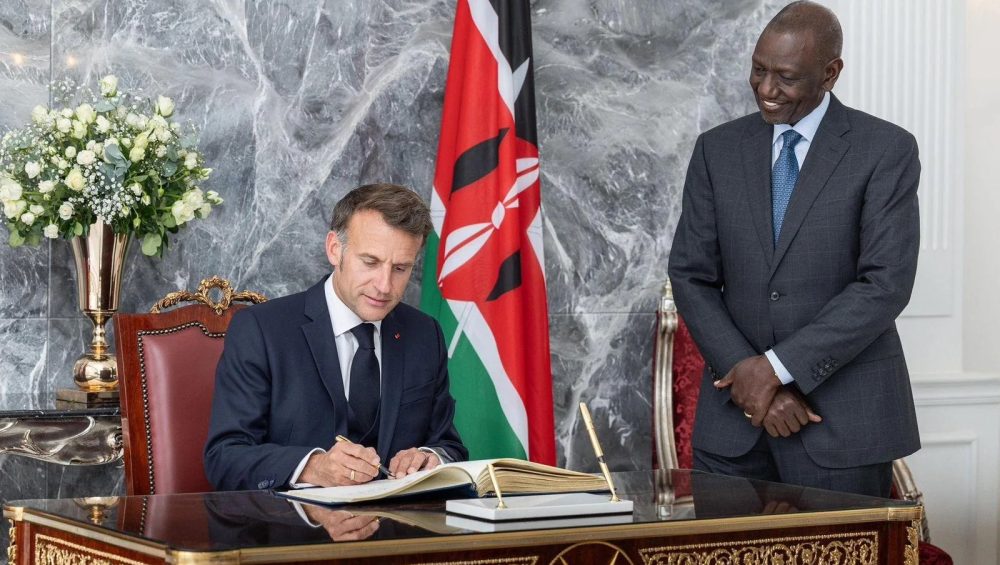
French President Emmanuel Macron’s visit to Nairobi and talks with President William Ruto come just before the opening of a two‑day Africa Forward Summit, the first ever held in an English‑speaking African country. The forum will bring together African leaders and business executives to discuss economic development and cross‑border investment, as France seeks to reset ties with the continent. For Kenya and Africa at large, the summit carries implications for trade, jobs, and regional cooperation, while for migrants it raises questions about whether new investment and partnerships can ease the pressures that drive mobility across borders.
French President Emmanuel Macron’s visit to Nairobi on May 10, 2026, and his meeting with President William Ruto set the stage for the Africa Forward Summit, a two‑day gathering that has drawn African leaders, business executives, and international partners. The summit, co‑hosted by Kenya and France, is the first of its kind to be held in an English‑speaking African country. It is framed as a forum for economic development, cross‑border investment, and renewed diplomatic engagement between Africa and Europe.
Macron’s arrival in Kenya followed stops in Egypt and precedes a visit to Ethiopia, underscoring France’s effort to reposition itself on the continent after years of strained ties with former colonies. Anti‑French sentiment has grown in parts of West Africa, where governments in Mali, Burkina Faso, and Niger have distanced themselves from Paris and embraced new alliances with Russia and China. France has vowed to abandon the “Francafrique” strategy, which critics say relied on political collusion, exclusive business deals, and opaque financial arrangements. By choosing Nairobi as a host city, Macron signaled a shift toward broader engagement beyond Francophone Africa.
For Kenya, the summit is a diplomatic milestone. President Ruto has sought to elevate Nairobi’s role as a continental hub, positioning Kenya as a gateway for global partnerships. Hosting the Africa Forward Summit places Kenya at the center of discussions on trade, investment, and innovation. Prime Cabinet Secretary Musalia Mudavadi described the gathering as an opportunity to unlock investment pipelines, create jobs, and position Africa as a driver of global economic transformation.
The summit’s agenda emphasizes entrepreneurship, technology, climate finance, and infrastructure. More than 30 African heads of state and thousands of delegates are expected to participate. For African governments, the forum offers a chance to attract investment and strengthen ties with Europe at a time when competition for influence on the continent is intensifying. For France, it is an opportunity to demonstrate that its engagement is no longer limited to former colonies but extends to Anglophone Africa and beyond.
Migration is not listed as a headline theme of the summit, but it remains an underlying issue. Millions of Africans move across borders for work, education, and trade, and the pressures driving migration—unemployment, poverty, and insecurity—are directly linked to the summit’s focus on jobs and enterprise. Analysts note that investment in industries and technology could reduce the push factors that compel young Africans to seek opportunities abroad. At the same time, stronger partnerships with Europe may open pathways for skilled workers, students, and entrepreneurs, while raising questions about protections for low‑skilled migrants who remain vulnerable to exploitation and xenophobia.
For Kenyan migrants, the summit carries both opportunities and challenges. Stronger Kenya‑France ties could expand access to European markets for skilled professionals and students. However, the emphasis on private sector growth may not immediately address the vulnerabilities of truck drivers, traders, and low‑wage workers who face insecurity in regional trade corridors. Migrant Narratives Africa has documented how drivers transporting goods into Congo, for example, are exposed to violence and extortion. Whether summit commitments translate into tangible protections for such communities remains to be seen.
Across Africa, diaspora communities are watching closely. Governments have pledged to create jobs at home, but migrants abroad continue to face discrimination and xenophobia, as seen in recent attacks in South Africa. The summit’s outcomes will be measured not only in investment figures but also in whether they contribute to safer mobility, fair treatment of African workers, and stronger protections for migrants.
Macron’s Africa tour reflects broader geopolitical shifts. With Russia and China expanding their influence, Europe is seeking to reassert its role. France’s emphasis on entrepreneurship and youth development is part of a strategy to appeal to Africa’s growing population, where more than 60 percent are under the age of 25. By focusing on innovation and enterprise, Macron hopes to present France as a partner in Africa’s future rather than a relic of colonial past.
For President Ruto, the summit is also a chance to showcase Kenya’s leadership. Nairobi has positioned itself as a hub for technology and innovation, with initiatives in fintech, renewable energy, and digital platforms. By co‑hosting the summit, Ruto underscores Kenya’s role in shaping continental conversations on development and global partnerships.
The Africa Forward Summit is expected to produce commitments on investment, climate finance, and technology transfer. Observers will be watching to see whether these translate into concrete projects and whether they address the realities of migration, employment, and regional security. For migrants, the hope is that investment in local industries will reduce the need for risky journeys abroad, while partnerships with Europe will ensure fair treatment and opportunities for those who do move.
As Macron and Ruto co‑host the summit, the stakes are high. For Kenya, it is a chance to cement its place as a continental leader. For Africa, it is an opportunity to redefine relations with Europe in a multipolar world. And for migrants, it is a moment of hope that solutions to insecurity, unemployment, and displacement will be part of the conversation—not just investment figures and diplomatic symbolism.