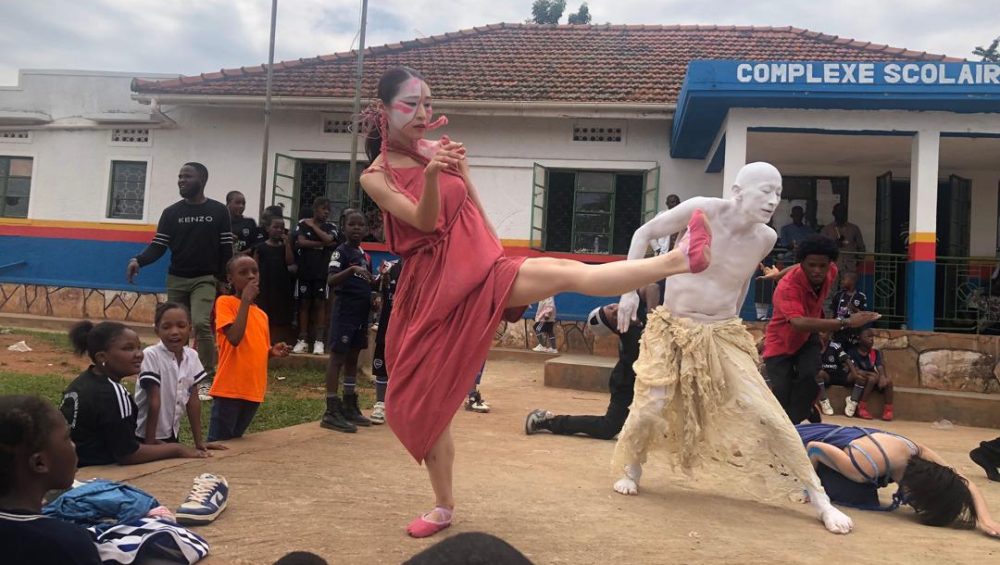
Japanese and Congolese artists joined forces to bring the healing power of dance to refugee students, many of whom carry the invisible scars of conflict from the Democratic Republic of Congo.
By Sibairwa Vincent and Moïse Bauma
In a heart-warming display of cultural unity and compassion, the halls of Complexe Scolaire Aigle du Ciel came alive with the rhythmic beats of an extraordinary event. Japanese and Congolese artists joined forces to bring the healing power of dance to refugee students, many of whom carry the invisible scars of conflict from the Democratic Republic of Congo.
The event, carefully curated to align with the school’s mission and values, was more than just a performance. It was a lifeline thrown to young minds grappling with the aftermath of trauma. As the music began, the administrative staff watched in awe as their students, often burdened by their past, began to move with newfound freedom and joy.
At the heart of this transformative experience was a workshop led by an impressive ensemble of artists. From Japan, the talented trio of Akihito Ichihara, Natsuki Takakuwa, and Konoka Hyakuna of the ELF Dance Project brought their unique flair. Joining them was Congolese artists Aicha Muteba and his crew Interpol d’art, adding a touch of home to the multicultural mix.
“This workshop isn’t just about learning dance steps. It’s about giving these young people a safe space to process their experiences, build confidence, and find joy in self-expression. Working with Streaming Asylum in this initiative is a powerful reminder of how art can heal and unite, regardless of our backgrounds, Akihito Ichihara said.
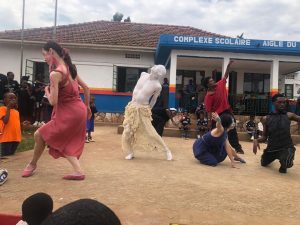
Photo Courtesy/ Streaming Asylum
As traditional Japanese movements blended seamlessly with Congolese rhythms, something magical happened. The refugee students, initially hesitant, found themselves drawn into a world where language barriers dissolved and expression knew no bounds. With each step and gesture, they seemed to shed layers of anxiety and fear, replacing them with confidence and curiosity.
Esther, 13 years old: “I’ve always been shy in class, afraid to speak up. But during the dance, I felt brave. I even led a small group! I think this confidence will help me in my studies too.”
Emmanuel, 17 years old: “This event opened my eyes. I realized that even though we’ve been through tough times, we can still create beautiful things. It made me curious about other forms of art and how they can help us heal.”
The event, co-organized by Streaming Asylum, was more than entertainment. It was a crucial step in the healing process. Mental health challenges have long plagued these young refugees, their minds haunted by the horrors that forced them to flee their homeland. But in the safe space created by the dance, they found a new way to process their experiences and emotions.
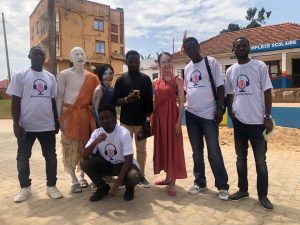
Photo Courtesy/ Streaming Asylum
“By holding these community engagement events, we want to show that mental health care can come in many forms. We believe in the power of the arts to inspire healing, and today’s workshop is just the first step in helping these students find their voice, confidence, and a way to cope with challenges they face.” RUYANGE Jean-Fraterne, Executive Director of Streaming Asylum shared.
School administrators beamed with pride as they witnessed the transformation. They recognized that this wasn’t just about relaxation though that was a welcome benefit. They saw the potential for improved academic performance, as students learned to channel their energy and emotions in positive ways. Moreover, they watched as invisible barriers between students began to crumble, paving the way for easier social interactions and a more cohesive school community.
Looking back on the event, Aïcha Muteba’s assessment was clear: “I’m honoured to be part of this collaboration with Streaming Asylum, and to bring the ELF Dance Project’s philosophy to these refugee students. Dance is a universal language—it allows people to express what words sometimes cannot. For many of these students, who have faced intense challenges, movement can offer an emotional release and a way to reconnect with themselves.”
As the workshop progressed, it became clear that this was more than a one-time event. The students were being given tools for ongoing self-expression, a new language of movement that they could carry with them long after the music faded. The confidence gained through dance promised to spill over into other areas of their lives, empowering them to engage more fully with the world around them.
When the final notes played and the last steps were taken, the impact was palpable. Smiles adorned faces that had known too much sorrow. Laughter echoed through halls that had heard too many sighs. And in the eyes of each student, there was a newfound spark—a glimmer of hope for a future where they could express themselves freely and without fear.
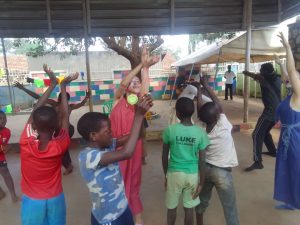
Photo Courtesy/ Streaming Asylum
The Healing Dance had done its work, proving that sometimes, the most profound therapy doesn’t require words. In the universal language of movement, these young refugees had found a new beginning—a chance to rewrite their stories, one step at a time.
Story Courtesy,
Streaming Asylum,
ED: Jean Fraterne Ruyange