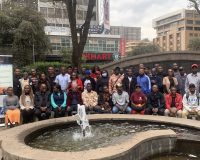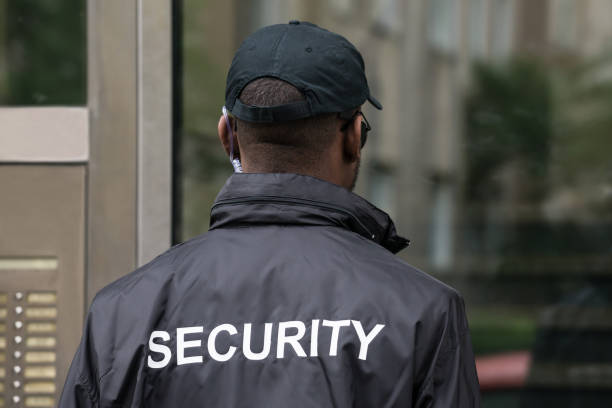
In Bahrain, a group of Sudanese men—once teachers, athletes, and professionals—now work long hours as low-paid security guards. They fled a brutal war for safety, but found themselves trapped in the Gulf’s exploitative labour system.
Manama, Bahrain
They came from Sudan’s cities—Dongola, Omdurman, Khartoum—bringing with them degrees, teaching experience, and dreams of better lives. Back home, they were respected professionals, educators, and promising athletes. Today, in Bahrain, they stand for hours at government facilities as security guards, earning a fraction of what they were promised.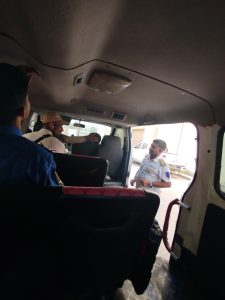
For Sudanese workers, their Arab heritage offers some advantage in the Gulf. They share language, religion, and cultural ties with the region’s economic giants. In theory, these ties open doors to public service roles and better-paying jobs. But for this group, the road to Bahrain was paved not with opportunity, but with desperation. War forced their hand, pushing them to accept whatever work was available.
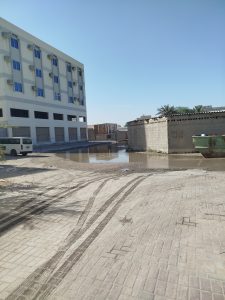
Most arrived after Sudan’s latest conflict erupted in April 2023, though a few had come earlier during years of political and economic decline. Today, they live in Tubli, a working-class district of Bahrain known for housing migrant labourers. Like industrial zones in other Gulf states, it is tucked away from tourist eyes, absent from many street-view maps.
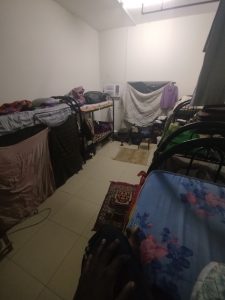
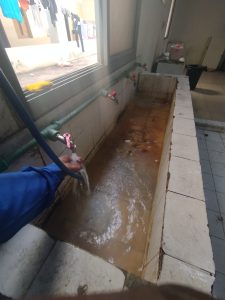
Inside their crowded accommodation, 150 men share a single floor, a communal kitchen, and a few toilets. Drinking water is recycled from a nearby plant—undrinkable without boiling. Privacy is rare; the air is heavy with sweat, cooking fumes, and the weariness of men working 14 to 16 hours a day.
Life as a Guard
Musab, a soft-spoken man in his mid-30s, welcomes me into his small shared room. Back in Khartoum, he taught history at a primary school. In Bahrain, he guards an electricity and water facility in Riffa. The work is basic—standing post, patrolling occasionally—but the hours are relentless. His shifts stretch to 14 hours, without days off.
When Musab left Sudan, an agent in Cairo promised him a tax-free salary of 450 Bahraini Dinars (BD) per month. But on arrival, the reality hit: no unskilled worker in Bahrain earns that much. His actual pay is just 100 BD—less than a quarter of what he was told. There is no medical cover, no paid leave, and no overtime pay.
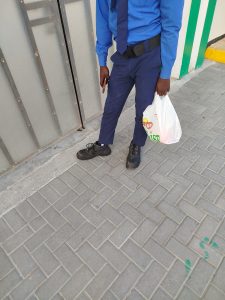
In the next room lives Ali, 25, the youngest of the Sudanese group. Tall, dark-skinned, and athletic, Ali once dreamed of playing football in Europe. He played in Khartoum’s local leagues but could not find a sponsor. With migration to Europe nearly impossible, Bahrain became his last option.
Ali works the night shift at the same utility company. By day, he runs a makeshift barbershop in his room, charging 1 BD per haircut. The extra cash helps, but it comes at a cost—he often naps at work, and if caught, risks losing half his salary for that month.
The Long Road Out of Sudan
Both Musab and Ali left Sudan during the chaos of war. They paid agents in Egypt thousands of dollars for what they thought would be stable, decent-paying jobs. Instead, they were pulled into a system where foreign workers are paid less, work longer hours, and enjoy none of the protections guaranteed to citizens.
Bahraini guards at their company earn a minimum of 300 BD per month, work eight hours a day, and get regular days off. For foreign workers, the rules are different: shifts are nearly double in length, and days off are rare.
Ahmed, 35, has worked for the same security company for six years. He was part of the first wave of Sudanese who left after Omar al-Bashir’s fall in 2019. “We lost everything,” he says. “The family business collapsed. I washed cars in Cairo before finding an agent who got me here. I’ve been back to Sudan only twice.”
The company’s workforce is a patchwork of men from conflict zones and weak economies- Sudan, Nepal, Bangladesh, Pakistan, India among others. Sudanese guards here share one room, number six, regardless of tribe or political views. Sometimes tensions flare, either among themselves or with other nationalities. Company management rarely intervenes unless fights draw blood—then the police are called, and jail or deportation often follows.
A System Built for Control
In the Gulf, hiring based on ethnicity and nationality is a long-standing practice. It thrives under the kafala system, a sponsorship-based labour arrangement where a migrant worker’s legal status is tied to their employer. Workers cannot change jobs, leave the country, or renew their visas without their employer’s approval.
Critics say the system fuels exploitation—wages withheld, passports confiscated, and workers trapped in contracts they did not agree to. Sudanese guards in Bahrain feel it acutely. Some have tried to return to teaching, but the kafala restrictions and lack of recognition for foreign qualifications keep them stuck in low-wage security jobs.
Muaz, from Omdurman, once trained to become a school principal. He is the oldest in the group and still carries himself like an educator—patient, measured, reserved. But there is an undercurrent of frustration. He distrusts me when he learns I am Kenyan, citing Kenya’s alleged ties to the RSF militia in Sudan. “Ruto is helping destroy Sudan,” he says bitterly. Muaz spends his spare time reading Sudanese news, quietly nursing the hope that he might one day return.
Desperation as Leverage
Recruitment agents know the value of desperation. In conflict zones, people will pay almost anything for a chance at safety. Sudanese guards here paid as much as USD 3,000 to secure jobs in Bahrain—salaries as low as 60 BD a month. Bahrain has no minimum wage law for foreigners, and its labour authority focuses on issuing visas and collecting fees, not on protecting workers.
Officially, these Sudanese are “expats,” but the term suggests privilege and choice—neither of which apply here. They are not recognised as refugees, so they fall into a grey zone where exploitation is easy and accountability is rare.
Holding On to Hope
Not all dreams have been abandoned. Sa’ad, also Sudanese, has been in Bahrain for three years. He has saved enough to buy a used Mitsubishi worth 1,500 BD, which he plans to use for food delivery work once he secures a freelance visa. Under the kafala system, this means paying a private sponsor for the right to work independently and renewing that permit annually.
“I sacrificed,” Sa’ad says. “I didn’t send money home. I’m not married, so I saved most of my salary. I want to stay here longer. Life isn’t easy, but it’s safe. In Sudan, there is no peace.” His free time is limited to evenings, when the men gather to smoke shisha and play Sudanese music—a brief escape from the grind.
Musab and Ali, too, cling to patience. They know Bahrain offers little in the way of upward mobility, but for now, it offers peace.
Sudan’s Ongoing War
The conflict that pushed them out began in April 2023, a violent power struggle between the Sudanese Armed Forces (SAF), led by General Abdel Fattah al-Burhan, and the Rapid Support Forces (RSF), commanded by Mohamed Hamdan Dagalo (Hemedti).
The war erupted after disputes over the integration of forces and the transition to civilian rule following al-Bashir’s fall in 2019. It has left thousands dead, millions displaced, and cities like Khartoum and Darfur in ruins. Peace talks have repeatedly failed, leaving Sudanese inside and outside the country in limbo.
In Bahrain, far from home, these men work and wait—teachers without classrooms, athletes without fields, citizens without a country.