South Africa’s June 30 anti‑immigration protests, staged under a self‑declared deadline for undocumented foreigners to leave, escalated tensions across major cities and spilled over onto documented migrants, who found themselves evicted, harassed, and targeted simply for being foreign. While organizers insisted their campaign was aimed at “illegal immigrants,” the marches blurred distinctions between lawful residents and the undocumented, leaving thousands of migrants — with or without papers — fearing for their safety, livelihoods, and dignity.
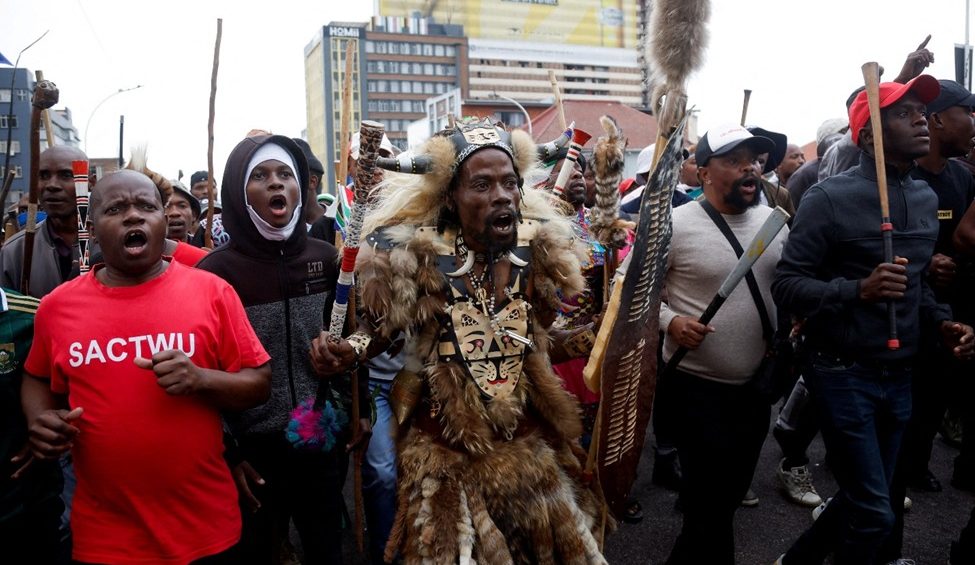
South Africa’s streets fell under a tense hush as thousands of protesters marched against migrants, marking a self‑declared deadline for undocumented foreigners to leave the country. Organized by grassroots movements such as March and March and Operation Dudula, the demonstrations spread across Johannesburg, Durban, Cape Town, and Pretoria. While many marches remained peaceful, sporadic violence, looting, and intimidation underscored the fragility of coexistence in Africa’s most industrialized nation.
Shops owned by foreign nationals closed preemptively, fearing attacks. Police deployed armored vehicles, helicopters, and tactical units, while the military stood on standby. In Johannesburg’s Thembisa suburb, rioters hurled stones at police and suspected migrants, with sporadic gunfire reported near the central business district. In Soweto, protesters looted shacks belonging to foreign nationals, prompting police to fire rubber bullets. Durban saw one of the largest marches, with thousands chanting anti‑migrant slogans under the leadership of Jacinta Ngobese. “For the next six months, we are asking for our national resources to be used to take the illegal immigrants out of this country. From building to building — they must go,” Ngobese declared.
Fear Beyond the Undocumented
What made June 30 particularly alarming was the way hostility spilled over onto documented migrants — those with legal papers, work permits, or refugee status. Witnesses reported landlords evicting foreign tenants in Durban and Johannesburg, regardless of their legal standing, fearing vandalism of their buildings. In Durban, about 100 Congolese nationals, many with valid permits, were chased from their homes and forced to sleep on the streets.
Malawian families queued to board buses home, their belongings piled in white tents dismantled by authorities. “We came in search of work, but now we are told to go back because we don’t have the right papers,” said Nelson Mbewe, a Malawian migrant interviewed by the BBC. Yet many of those leaving had proper documentation — highlighting how the protests blurred distinctions between legal and illegal migrants.
Government Response
President Cyril Ramaphosa condemned the violence but acknowledged public frustration. “South Africans’ deep concerns about illegal immigration are real and they deserve to be heard,” he said, while stressing that “the right to protest does not allow people to threaten or intimidate others, or to engage in acts of vandalism or violence.” His government announced a five‑point plan to tighten border controls, establish immigration courts, and penalize employers who exploit undocumented workers.
Officials emphasized that the June 30 “deadline” was not legally sanctioned. The Department of Home Affairs warned against vigilantism, noting that immigration enforcement remains the responsibility of the state. Yet critics argue that political rhetoric has hardened, with some politicians echoing protesters’ concerns to win votes ahead of local elections.
Human Impact
Human rights organizations reported at least four migrant deaths in the weeks leading up to the protests, including nationals from Mozambique, Ethiopia, and Malawi. Consulates in Johannesburg and Pretoria were overwhelmed as thousands sought emergency repatriation. Zimbabwe, Malawi, and Nigeria organized buses and flights to evacuate citizens, while Ghana and Uganda opened temporary centers for distressed nationals. Police confirmed more than 25,000 migrants have been repatriated since January.
But the impact extended to documented migrants, who found themselves targeted simply for being foreign. “I have a work permit, but my neighbors told me to leave before June 30,” said a Nigerian teacher in Pretoria. “They don’t care about papers. To them, we are all outsiders.”
Drivers of Discontent
South Africa’s unemployment rate remains above 30 percent, with youth unemployment even higher. Rising crime and poor service delivery have fueled frustration, creating fertile ground for populist narratives that blame migrants for economic stagnation.
“Immigrants are being scapegoated for systemic failures,” said a researcher at the African Centre for Migration & Society. “The protests reflect broader anxieties about inequality, but targeting migrants risks repeating the deadly xenophobic outbreaks of 2008, 2015, and 2019.”
Civil society groups argue that online misinformation has amplified hostility. Social media campaigns portraying migrants as criminals or economic burdens have gained traction, spilling into offline mobilization.
Regional and Civil Society Reactions
Neighboring states expressed concern over the safety of their citizens. Zimbabwe’s Ministry of Foreign Affairs urged calm, while Malawi’s government coordinated evacuation flights. Nigerian officials condemned xenophobic rhetoric, calling for stronger African Union intervention.
Civil society organizations in South Africa staged counter‑protests, emphasizing that migrants contribute to the economy and enrich cultural diversity. “Digital misinformation is spilling into the streets,” said one activist in Durban. “If exclusionary narratives are not challenged, xenophobia risks becoming normalized as public policy.”
Police Preparedness
Unlike the deadly unrest of July 2021, authorities mobilized extensively. More than 13,000 SAPS officers and 217,000 private security personnel were deployed nationwide. Analysts noted that this preparedness prevented mass chaos, though isolated incidents of looting and harassment were reported.
Migrant Voices
For migrants, the protests were not abstract politics but lived danger. “We came here to work, not to fight,” said a Zimbabwean shopkeeper in Johannesburg. “But every day, we are told we don’t belong.”
An Ethiopian asylum seeker in Pretoria described fear of leaving home: “Even walking to the market feels dangerous. We are blamed for problems we did not create.”
Documented migrants echoed similar fears. “I have refugee status, but my landlord told me to leave before the march,” said a Congolese woman in Durban. “The papers don’t protect us when mobs come.”
Analysis
The protests highlight the intersection of economic hardship, political populism, and digital misinformation. While organizers frame their actions as patriotic, critics argue they exploit frustrations for political gain.
Experts warn that unless South Africa addresses structural issues — unemployment, inequality, and service delivery — migrants will remain convenient scapegoats. Regional cooperation, fact‑based reporting, and inclusive policy frameworks are seen as essential to countering xenophobia.
Conclusion
South Africa’s June 30 demonstrations underscore the fragility of coexistence in a nation grappling with economic and social pressures. For migrant communities, the protests represent not just political theatre but existential threats to safety and dignity.
As civil society leaders stress, the challenge is not only to enforce immigration law but to confront the narratives that fuel division. Without sustained efforts to counter misinformation and promote inclusion, xenophobia risks becoming entrenched in South Africa’s political landscape — affecting not only undocumented migrants but those who are legally recognized.