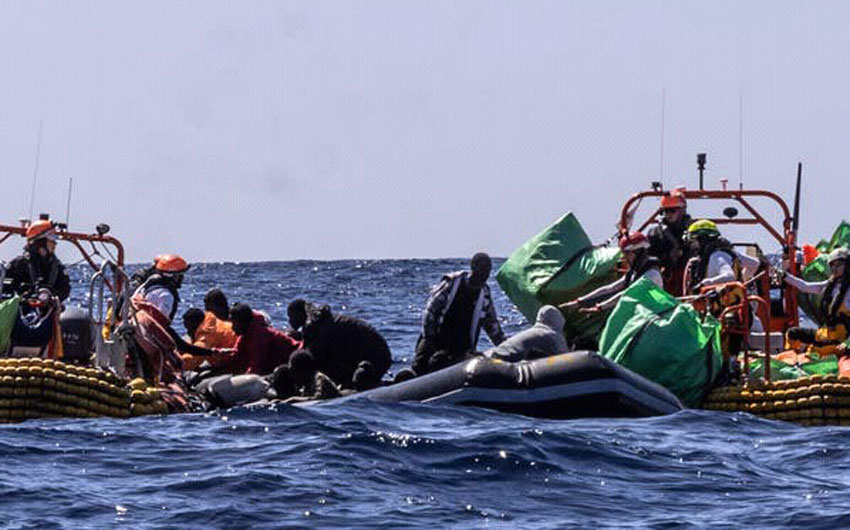
The International Organization for Migration (IOM) has called on all governments and authorities along the central Mediterranean migrant route to enhance regional cooperation to ensure the safety and protection of migrants.
IOM says this should be done, regardless of their status and across all stages of their journeys. This migration route is utilized by Africans who, in a desperate effort to enhance the quality of their lives, end up undertaking perilous journeys to escape harsh economic conditions in their respective nations and seek better opportunities in Europe.
Most of them end up drowning in the sea. It’s a grim reality. In November 2014, Pope Francis urged European leaders to stop the Mediterranean Sea from becoming a “vast cemetery” for migrants, a call that has relentlessly been echoed by IOM.
However, these calls have persistently fallen on the deaf ears of disinterested world policymakers and duty bearers, who have responded with insufficient efforts to address the situation. Consequently, the carnage has continued to escalate rather than abate.
Recent data from the Italian Interior Ministry record that 5,968 migrants have arrived by sea so far this year, down from 19,937 at the same stage in 2023. These statistics indicate that more tragic incidents must have occurred, because only 3 in 10 African migrants trying to flee to Europe for better life reach their destination.
According to the Missing Migrants Project, at least 3,129 deaths and disappearances have been recorded in 2023 along the Mediterranean route, not including this latest incident.
Additionally, IOM says that almost 2,500 migrants died or went missing attempting the crossing last year, and 226 since the start of 2024. IOM spokesperson Flavio Di Giacomo said that more than 2,250 people have died this year on the central Mediterranean migrant route, saying this was a “dramatic figure which demonstrates that unfortunately not enough is being done to save lives at sea.”
The Paradox
Known for its crystal-clear blue water, impressive sunsets, and top vacation destinations, calling the Mediterranean Sea a “graveyard” seems rather paradoxical. However, this sea has, in fact, become the cemetery for thousands of migrants who have drowned along the Central Mediterranean route, which is considered to be the world’s deadliest migration route.
These migrants originate from various regions, with the majority traveling from Sub-Saharan Africa. Despite the magnitude of the problem, this issue has received limited media coverage and adequate life-saving solutions.
Charity groups like SOS Mediterranee and others complain that Italy’s right-wing government is obstructing their search and rescue (SAR) activities, forcing them to travel to distant ports to disembark migrants and often temporarily impounding their ships.
Recently IOM expressed shock and raised alarm after the discovery of at least 65 migrants’ bodies in a mass grave in Southwest Libya. The circumstance of their death and nationalities remain shrouded in mystery, but it is believed that they died in the process of being smuggled through the desert.
“Each report of a missing migrant or a loss of life represents a grieving family searching for answers about their loved ones or acknowledging the tragedy of the loss,” said an IOM Spokesperson Di Giacomo, in a press statement.
“The cost of inadequate action is evident in the increasing human deaths and the disturbing conditions migrants find themselves in,” he added.
This latest tragedy highlights the urgent need to address the challenges of irregular migration including through a coordinated response to the smuggling of migrants and trafficking in persons. Without regular pathways that provide opportunities for legal migration, such tragedies will continue to be a feature along this route.
Double Standards Makes the Phenomenon Persist
As earlier asserted, the scourge of war, which has brought unforetold suffering to Africans in states riddled by civil turmoil, has been the number one cause of these tragic incidents, coupled with economic mismanagement perpetuated by different corrupt governments in Africa.
This has led to Africans’ weakened affection for their home countries due to serious economic hardships. In turn, some have embarked on perilous journeys to Europe, hence this phenomenon. However, circumstances surrounding their drowning is not only attributed to recklessness of their sailors and traffickers.
There is also an element of double standards attitude from there would be destination countries, rescuers and other authorities along the central Mediterranean migrant route.
Roza E. Patterson, the Deputy General Attorney at the California Department of Justice argues that the lack of proposed solutions concerning the drowning of African migrants can be understood through the metaphor of the “Dark Continent,” which has been used for centuries to “other” Africans in western philosophy and consciousness.
She also contended that, at least in the United State and other European countries, racist attitudes towards Blacks more generally also play a significant role in the lack of public concern for this issue. Patterson’s assertions are clearly proven in the 2011 case study.
The Case Study
In 2011, the Mediterranean Sea witnessed a staggering loss of life as at least 1,500 individuals perished while attempting perilous crossings. Among the numerous tragedies, one particularly harrowing incident, as uncovered by the British newspaper The Guardian, involved a small rubber boat departing from Tripoli, Libya on March 26, 2011, carrying 72 individuals. However, 15 days later, the boat was discovered washed up on the shores of Libya with only nine survivors.
What distinguished this case, beyond the sheer magnitude of lives lost, was the apparent disregard for distress calls from the stricken vessel. Despite the presence of numerous fishing vessels, a military helicopter allegedly belonging to the North Atlantic Treaty Organization (NATO), and a sizable naval vessel, the calls for help went unanswered.
While many were reported missing in similar incidents, the individuals aboard this ill-fated boat could have been rescued if all involved had fulfilled their obligations to respond to distress signals promptly and effectively.
Way Forward
The Mediterranean Sea drowning of African Migrants can be tackled as follows:
Regular patrols should be enforced along this dangerous route to curtail any attempts by Africans to flee to Europe via sea, amending the International Maritime Search and Rescue Convention is crucial to address vacuums of responsibility, particularly in cases like Libya’s. Clear guidelines for distress signals must be established to ensure swift responses, while uniform interpretations of distress criteria are essential to aid overloaded or unseaworthy vessels promptly.
According to a 2012 report by the Committee on Migration, Refugees and Displaced Persons, tackling the reluctance of commercial vessels to assist distressed boats requires addressing economic consequences, resolving disagreements over disembarkation ports, and legislating against shipmasters who fail to act.
Additionally, the report suggests compliance with human rights obligations and effective responsibility-sharing among EU states are vital to uphold human dignity and alleviate burdens on frontline nations, as a solution to these drownings.
In the final analysis, addressing Mediterranean drowning of Africans requires legal, operational, and humanitarian measures enacted through international cooperation and coordinated efforts to save lives and uphold human dignity at sea.