This sudden takeover marks yet another chapter in a crisis that has already displaced civilians, and left the region at the mercy of armed groups. It is a significant shift in the devastating conflict that has gripped the region for years.
Hundreds of thousands of civilians have been massively displaced and subjected to suffering in Goma, the capital of North Kivu in the Democratic Republic of Congo (DRC), after the M23 rebel group declared its capture on Monday, January 27, 2024.
This sudden takeover marks yet another chapter in a crisis that has already displaced civilians, and left the region at the mercy of armed groups. It is a significant shift in the devastating conflict that has gripped the region for years.
The Democratic Republic of Congo and the United Nations have constantly accused Rwanda of allegedly supporting M23 with troops and weapons, charges which Rwanda has denied.
M23, through its political wing, the Alliance Fleuve Congo (AFC), announced the “liberation” of the city.
Lawrence Kanyuka, a spokesperson for the group, urged residents to remain calm, stating, “The liberation of the city has been successfully carried out, and the situation is under control.”
This announcement, however, could not mask the impending humanitarian disaster unfolding across Goma and the surrounding areas. The rapid advancement of the M23 rebels left the city in chaos, with many civilians caught in a deadly crossfire between armed groups and retreating government forces.
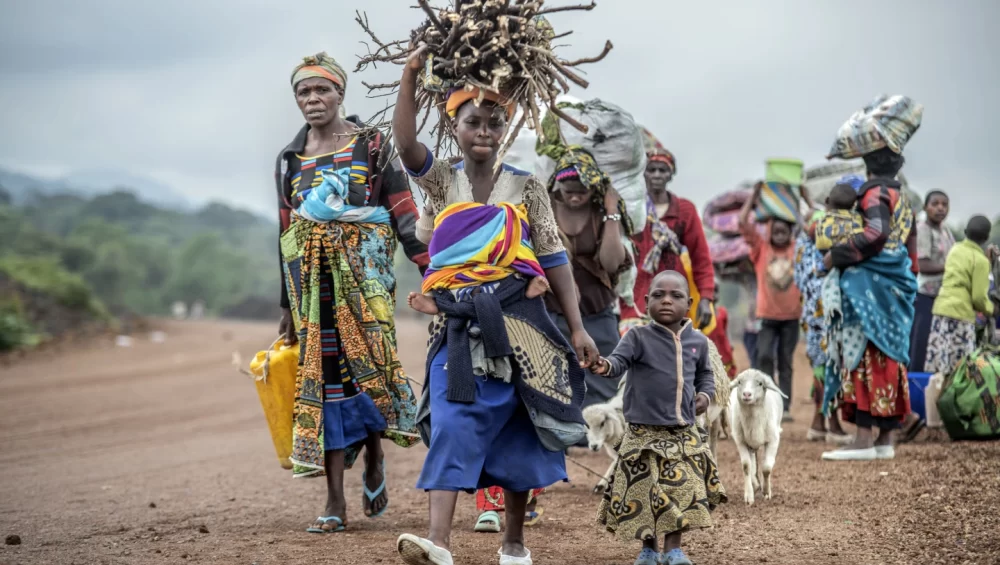
As the violence escalated, hospitals that were already overwhelmed with casualties could no longer cope with the surge of wounded residents. The situation in internally displaced persons (IDP) camps, which had been sheltering many of Goma’s most vulnerable, grew even worse. The ongoing shelling intensified, forcing families who had already been displaced to flee once more, clutching whatever belongings they could salvage, with the sounds of explosions echoing in their ears.
Photo Courtesy/ AP
The city, home to nearly two million people, became a site of mass panic. As some residents huddled in their homes, fearful for their lives, others undertook arduous treks to escape the violence. Families, including young children, sought refuge in the rural parts of North Kivu or crossed the border into Rwanda, desperate to find safety.
“We are fleeing because we saw soldiers on the border with Rwanda throwing bombs and shooting,” said Safi Shangwe, a woman who was among the thousands of people desperately trying to leave. The grim sight of people trying to escape was compounded by reports that Congolese forces had surrendered to the advancing rebels, further escalating the crisis.
A Worsening Humanitarian Crisis
The consequences of the M23 capture go far beyond the immediate violence. The UN has warned that this latest flare-up could lead to catastrophic impacts on the already vulnerable civilian population. Ravina Shamdasani, spokesperson for the UN human rights office (OHCHR), expressed grave concern about the heightened risk of human rights violations, particularly sexual violence, which has become a horrific trademark of the conflict. Women and girls are at increased risk of being abducted, subjected to sexual slavery, and, in many cases, killed after being raped.
The human cost of this conflict is already staggering. Since the beginning of the year alone, some 400,000 people in North and South Kivu have been displaced, with many seeking refuge in overcrowded and dangerous camps. Bombings of these camps, such as the tragic attack on the Kitalaga site in South Kivu that killed two children, highlight the indiscriminate nature of the violence affecting civilians. Other camps, like those near Goma, have been targeted by artillery fire, forcing many to flee again in search of safety.
The United Nations High Commissioner for Refugees (UNHCR) has painted a dire picture of the situation, with spokesperson Matt Saltmarsh warning that “the options for civilians are stark and extremely limited.” Aid is scarce, and the access to displacement sites is becoming increasingly difficult due to the presence of armed groups. For those trapped in these camps, the prospect of receiving adequate assistance grows slimmer by the day. The harsh reality is that, for many civilians, survival is a daily struggle marked by limited food, water, medical care, and basic necessities.
The Strain on Healthcare and Services
Hospitals in the region, already operating beyond capacity due to the ongoing conflict, are now on the brink of collapse. The influx of injured civilians continues to overwhelm medical staff, and without sufficient supplies or infrastructure, the quality of care is deteriorating rapidly. Vulnerable groups, including children, the elderly, and pregnant women, are the hardest hit. They live in overcrowded conditions, where the threat of disease and malnutrition looms large.
In the face of such widespread suffering, the international community’s response has been slow and insufficient. The UN peacekeeping mission (MONUSCO), with its presence of 14,000 peacekeepers, has not been able to effectively protect civilians or stem the violence. Despite their efforts, the continued attacks by M23 rebels, along with the collapse of law and order, have only deepened the suffering of those caught in the conflict.
As Goma falls under the control of the M23 rebels, the future remains uncertain for the millions of people living in North and South Kivu. The humanitarian crisis is not just a consequence of the violence but also a reflection of the long-standing instability that has plagued the region. The lack of security, combined with limited access to aid, has left civilians facing an uncertain and perilous future.
The UN also said it would temporarily relocate nonessential staff, such as administrative staff, from Goma.
“Essential personnel remain on the ground, sustaining critical operations such as food distribution, medical assistance, shelter, and protection for vulnerable communities,” the UN said.