Historically, Kenya has witnessed the power of mediation firsthand — most notably during the 2007–2008 post-election crisis, when a peace deal was brokered through negotiations led by former UN Secretary-General Kofi Annan. The devastating conflict, which claimed over 1,000 lives and displaced hundreds of thousands, underscored the dire consequences of unresolved tensions — and the redemptive role of structured dialogue.
WADR now hopes to inspire similar leadership in mediation, not just from international actors, but from within — led by homegrown professionals, especially women, who bring unique perspectives to peace building.
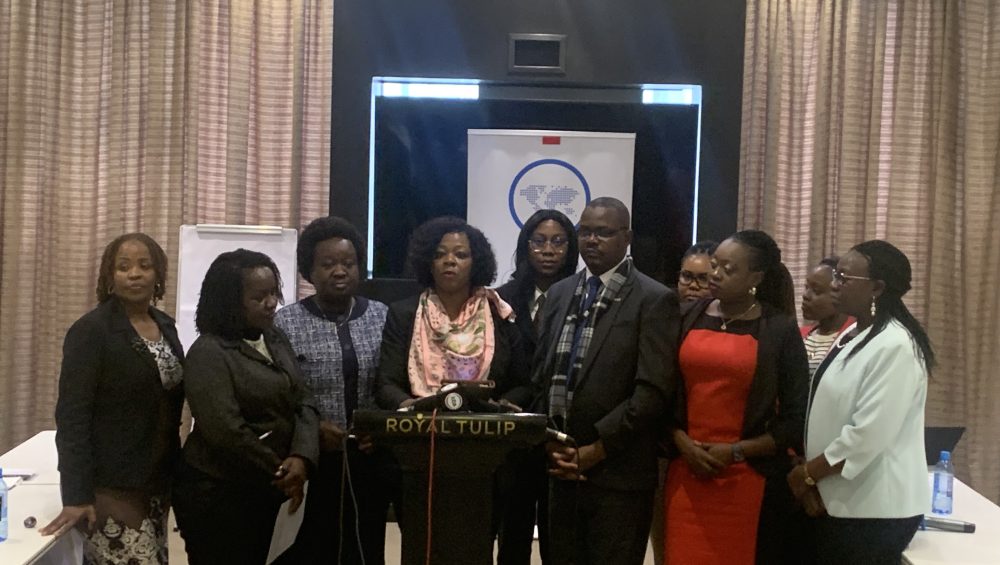
A leading coalition of women professionals under the banner of Women in Alternative Dispute Resolution (WADR) is calling on Kenyans to embrace dialogue, mediation, and reconciliation as the primary tools for resolving conflict — particularly in light of recent nationwide protests led by Gen Z demanding leadership reform and accountability.
The women, drawn from Kenya’s legal, corporate, and civil society sectors, say the country stands at a crossroads where peaceful resolution mechanisms must be prioritized to preserve national unity and economic resilience.
Speaking to journalists in Nairobi, WADR Chairperson Lumallas Eunice said the group is making a clarion call for Kenyans — from citizens to institutions — to adopt alternative dispute resolution (ADR) methods to prevent the escalation of tensions.
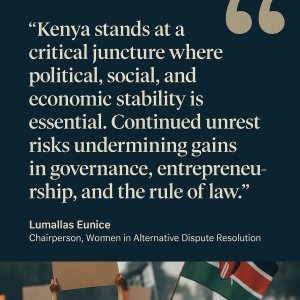
“Kenya stands at a critical juncture where political, social, and economic stability is essential. Continued unrest risks undermining gains in governance, entrepreneurship, and the rule of law,” she said. “We urge all sectors — the legal profession, business, and civil society — to promote empathy and a culture of resolving conflict amicably.”
She emphasized that mediation, conciliation, and other ADR strategies should be considered over adversarial or violent methods that tend to deepen rifts and destroy relationships. “The goal is not just legal resolution — but societal healing,” Lumallas added.
This comes at a time when frustrations over governance and economic hardships have spilled onto the streets, with youth-led protests and heightened political tension. WADR is advocating for the re-centering of Kenya’s long-standing traditions of dialogue and communal conflict resolution in addressing modern-day disputes.
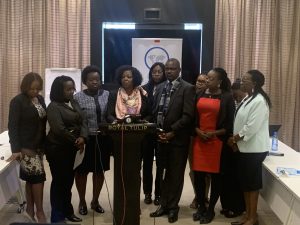
Women in Alternative Dispute Resolution (WADR)
Historically, Kenya has witnessed the power of mediation firsthand — most notably during the 2007–2008 post-election crisis, when a peace deal was brokered through negotiations led by former UN Secretary-General Kofi Annan. The devastating conflict, which claimed over 1,000 lives and displaced hundreds of thousands, underscored the dire consequences of unresolved tensions — and the redemptive role of structured dialogue.
WADR now hopes to inspire similar leadership in mediation, not just from international actors, but from within — led by homegrown professionals, especially women, who bring unique perspectives to peace building.
“Kenya cannot afford to let disputes metastasize into conflict,” WADR said in a statement. “The private sector needs predictability. Communities need healing. The nation needs vision.”
The group is encouraging the public to take five key steps toward peace:
- Embrace dialogue and mediation as first-line approaches to resolving disputes.
- Reject incitement and inflammatory rhetoric that provoke further tension.
- Support community and institutional peacebuilding initiatives.
- Foster a culture of lawful engagement and civic responsibility.
- Hold leaders accountable — but through constructive, non-violent means.
As calls for justice and reform grow louder across the country, WADR insists that conflict must be met with wisdom, not war; with understanding, not upheaval.
“This is not just a legal or policy concern — it is a moral imperative,” Lumallas said. “How we handle dissent defines who we are as a nation.”
About Women in Alternative Dispute Resolution (WADR)
WADR is a Kenyan-based initiative empowering women professionals in mediation, arbitration, and other alternative dispute resolution mechanisms. Through training, mentorship, and advocacy, WADR promotes ADR as a trusted, inclusive, and effective means of resolving disputes across Africa and beyond.