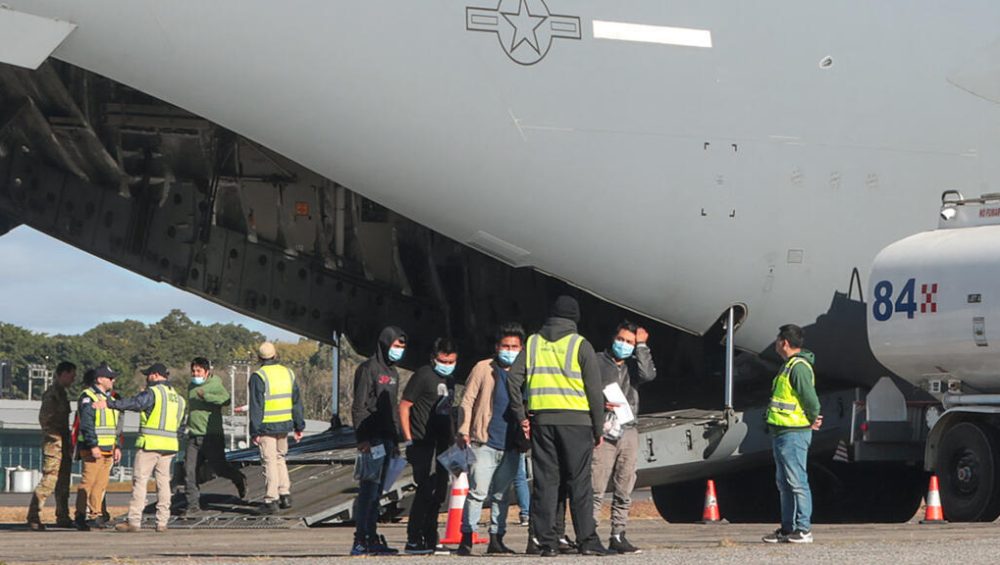
In a dramatic turn highlighting the complexities of U.S. deportation policy, five migrants who were slated for removal to Liberia this week refused to disembark from a government-chartered plane, forcing officials to reroute them to Equatorial Guinea instead.
Five migrants who refused to leave a US deportation aircraft in Liberia were reportedly flown to Equatorial Guinea.
According to two sources familiar with the matter, the Trump administration has increasingly relied on alternative African destinations as “loophole” deportation hubs when legal barriers prevent direct repatriation, underscoring both the resistance of migrants facing uncertain futures and the controversial tactics being used to enforce removals.
The incident marks an early setback in Washington’s plan to deport up to 1,200 migrants to Liberia — one of its biggest agreements with an African country, despite strong opposition from immigrant rights groups. Many of these migrants, known as “third‑country deportees,” have been granted legal protection in the U.S. after immigration judges ruled, they could face torture or other serious harm if sent back to their home countries.
Liberia announced on August 18 that it had agreed to accept deportees, with the first group of 20 scheduled to arrive on August 20. However, a Liberian official, speaking anonymously due to the sensitivity of the issue, told the media on August 21 that only 15 migrants actually disembarked.
At least five others — three Cuban men, one Brazilian man, and one Cameroonian woman — refused to leave the plane in Liberia, according to three sources familiar with the incident, including a Honduran deportee who was on board.
Officials initially told the group they would be flown back to the United States, but instead the plane continued on to Malabo, Equatorial Guinea. There, the five migrants were forced to disembark against their will, two of the sources said.
The five deportees are now being held alongside more than 30 other migrants previously sent to Equatorial Guinea under a U.S. deal. Like similar agreements across Africa, the arrangement has drawn sharp criticism from human rights groups, who argue that many of those deported eventually face repatriation despite protections. On August 21, the State Department reaffirmed its stance, saying it remains “unwavering in our commitment to end illegal and mass immigration and bolster America’s border security.”
A spokesperson for the Department of Homeland Security said the migrants “were deported to a safe third country,” adding: “If a judge finds an illegal alien has no right to be in this country, we are going to remove them. Period.”
According to sources, about 40 deportees are currently being held in Equatorial Guinea. Flight records from the ICE Flight Monitor, managed by Human Rights First, show that the plane carrying the group left Louisiana, stopped in Dakar, Senegal, and landed in Monrovia at 12:45 p.m. on August 20. The same records indicate the aircraft later departed for Malabo, arriving at 8:50 p.m. that evening.
According to Ahmed Soliman, an Egyptian migrant who arrived four months ago, 40 deportees are currently being held at a decommissioned hotel in Malabo. Rights groups — including Asian Americans Advancing Justice‑Atlanta and EG Justice — reported in July that conditions at the site are difficult, citing inadequate medical care, psychological distress, and lack of access to legal assistance. “These deportation agreements are moving people from one country to another without proper safeguards,” said Meredyth Yoon, Immigration Law and Policy Advocate.