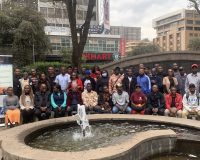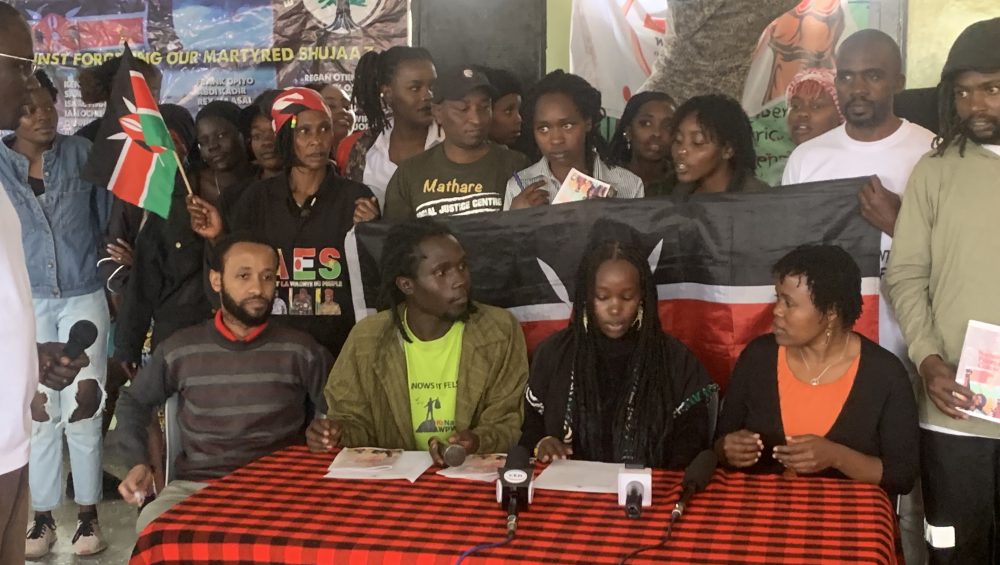
Speaking at Mathare Social Justice Centre on August 2, SJM Nairobi Chapter Spokesperson Wanjira Wanjiru said the council will serve as a national organ of representation driven by the collective will of citizens, not politicians. Backed by Convenor Davis Tafari, the movement rejected former Prime Minister Raila Odinga’s proposed intergenerational dialogue, insisting they are building an entirely new political leadership that excludes current political actors.
The Social Justice Movement (SJM), Nairobi Chapter, has declared the formation of a National People’s Council—an alternative political organ aimed at representing the collective will of Kenyans outside the mainstream political class. The announcement, made on August 2 at the Mathare Social Justice Centre, signals what the group describes as a shift toward “people-led political liberation” and the beginning of a new era for Kenya’s young generation demanding justice, dignity, and structural transformation.
Addressing journalists on the sidelines of the forum, Wanjira Wanjiru, the Nairobi Chapter Spokesperson, said the new council would act as a platform of representation for Kenyans who feel betrayed by the existing political establishment and its institutions. She said the movement is charting a path forward rooted in social justice, human rights, and the rule of law, in honour of all those who have died or suffered while resisting political repression and economic exclusion.
“This National People’s Council is the symbol of the sovereignty and power of the people of Kenya,” said Wanjiru. “We are not waiting for politicians to include us. We are organizing ourselves.”
The declaration follows a series of anti-government protests that have rocked the country since June 2024, including the “Occupy Parliament” movement and this year’s Saba Saba March, which saw widespread demonstrations across at least 25 counties. According to the Kenya National Commission on Human Rights (KNCHR), at least 70 protestors were killed between June 17 and July 7, 2025, with over 500 others injured and more than 532 arbitrarily arrested. The Commission described the government’s response as excessive and in violation of constitutional guarantees to peaceful assembly and expression.
SJM leaders said these statistics reflect the urgency of establishing an alternative people-centred leadership structure. The group emphasized that the state’s heavy-handed response to dissent—including police brutality, enforced disappearances, abductions, threats, and media censorship—reveals the depth of Kenya’s governance crisis. Wanjiru called it a moment for national reckoning, especially for young people who make up the majority of the country’s population.
“This is the generation that has been labelled ‘leaderless’—but we are showing that we are not only organized, we are determined to reshape Kenya’s political destiny,” she said.
Also present was Davis Tafari, the SJM Nairobi Chapter Convenor, who reiterated the group’s rejection of recent overtures by veteran opposition politician Raila Odinga, who in July proposed an “intergenerational national dialogue” to heal the country’s political divisions. Tafari said the movement was not interested in discussions that maintain the status quo or recycle existing leaders. Instead, he said, the National People’s Council would be built from the ground up, with leadership structures emerging from grassroots justice centres, communities, and young activists.

“We have nothing to gain from being co-opted into systems we oppose. The people’s revolution must be built outside the structures of those who have failed this country repeatedly,” Tafari told MNA.
When asked whether the movement has any external backers, Tafari clarified that SJM is open to working with both local and international actors, as long as they align with the group’s values of equity, justice, and people-led change.
“We shall and intend to work with both local and international organizations and individuals who are progressive and contribute positively to our mission,” he said. “But this movement remains anchored in Kenya’s own realities and struggles.”
At the heart of the movement’s declaration is a sharp critique of what it calls “neocolonial systems” sustained by exploitative economic policies, police repression, and elite political deals that ignore the lived realities of ordinary Kenyans. The statement issued by the group invoked the legacy of historical resistance movements, linking the current wave of youth activism to Kenya’s freedom fighters, including Mekatilili wa Menza, Koitalel Arap Samoei, Pio Gama Pinto, and Dedan Kimathi.
The statement also honoured victims of recent police violence, naming several by name—including Rex Masai, Denzel Omondi, Julia Njoki, Boniface Kariuki, and Albert Ojwang. These names have come to symbolize a growing sense of national grief and frustration, particularly among Gen Z Kenyans who led much of this year’s demonstrations under decentralized, tech-enabled organizing methods.
“We are walking in the footsteps of our ancestors, our freedom fighters, and the martyrs who have paid the price for freedom,” said Wanjiru. “Their blood is not in vain. We are building something they would be proud of.”
Legal experts and political observers say the formation of a National People’s Council—though symbolic at this stage—could evolve into a powerful grassroots platform if it continues to harness the momentum of civic unrest and youth frustration. Political analyst Kevin Okoth noted that while the council lacks formal constitutional recognition, its creation reflects a real political vacuum and the deepening disillusionment with both government and opposition actors.
“Young people are making it clear that they are not waiting to be invited into conversations. They are designing their own political spaces, and that is something to watch,” Okoth said in a phone interview.
The Social Justice Movement, which has active chapters in various informal settlements and counties, says it plans to expand the council’s presence nationally, holding consultations and forums that allow communities to raise their own demands and propose leadership from among themselves. While still in its formative stages, the council is expected to provide a political rallying point for future mobilizations and resistance campaigns.
The Nairobi forum concluded with chants of “Forward with the People’s Struggle” and “Long live land, food, and freedom!”—slogans that have become central to SJM’s messaging. Organizers distributed copies of the roadmap to the People’s Revolution, which outlines their principles and commitment to economic justice, anti-imperialism, and people-centred governance.
In an environment where youth-led dissent is often dismissed as chaotic or leaderless, SJM’s declaration of a structured political alternative may mark a new chapter in Kenya’s long-standing push for social justice and democratic accountability. Whether it will gain traction beyond urban justice hubs like Mathare remains to be seen, but its impact on the country’s political conversation is already being felt.
Why this story matters to MNA
This story matters to Migrant Narratives Africa (MNA) because it captures a critical shift in Kenya’s civic and political landscape, where young people—often marginalized in traditional political discourse—are asserting their agency and demanding structural change. By documenting grassroots-led initiatives like the formation of the National People’s Council, MNA affirms its mission to spotlight democratic movements, human rights struggles, and the evolving role of youth in shaping the future of governance across Africa. The story also resonates deeply with migration and displacement narratives, as many of the injustices highlighted—state violence, economic exclusion, and repression—are drivers of internal and cross-border displacement that MNA seeks to investigate and amplify.