“…In 2020, Mathare Social Justice Centre (MSJC) located in Mathare near Eastleigh, partnered with Counter Human Trafficking Trust-East Africa (CHTEA) to document and follow up cases of human trafficking and smuggling in Nairobi. The Eastleigh cases were among the priorities as there was an alarming increase in the frequency of this kind of cases every week… Most of them were employed as waged nannies and domestic workers…”
Nairobi is rapidly growing, metamorphosing from the Enkare Nyrobi ‘the place of cool waters’ that it used to be, to a busy, bustling metropolis. Before 1902, before that ‘iron snake’ foreseen by Mugo wa Kibiru slithered from the port city of Mombasa to the plains of the current city of Nairobi, wild animals ruled the savannahs. The Lunatic Express (the Uganda Railway) is credited with the birth of this “accidental city”, which was initially designed as a railway station. This station grew into a township and then into a city. Today, Nairobi is a major node for international capital flow boasting a thriving start-up ecosystem, a booming fintech, and other service-based sectors.
Nairobi is currently served by four main business districts: the central business district (CBD), Upper Hill, Westland, and Eastleigh. The latter is the only one that is found in Eastlands where it serves residents from the low-income neighbourhoods surrounding it. Today, it is predominantly a Somali neighbourhood beaming with various businesses ranging from textile, hotel industry, banking, finance, and forex among other MSMEs.
Its meteoric boom is a testament to the entrepreneurial spirit and acumen of the Somali people who have transformed this district from a bazaar-like archetype to a modern commerce centre. Before, it was punctuated with dirty untarmacked roads, potholes filled with sewage waste, and aging buildings. Today, high-rise buildings are being constructed day and night to accommodate new and expanding businesses such as the newly launched Business Bay Square Mall which is the largest mall in East and Central Africa in terms of floor space. In a few years to come, Eastleigh will be rivalling the other business districts in the affluent Westlands neighbourhoods of the city. Its growth in economic activities has attracted not only Nairobians and Kenyans generally but also other nationalities from other regions such as Uganda, Somalia, Ethiopia, Burundi, Tanzania, and South Sudan. Eastleigh has now become a 24-hour economy district due to the increased volume of business, improved access roads, and lighting.
This growth has come with its share of challenges that have exposed the ugly underbelly of this bustling business hub. Eastleigh has become the battleground where the thesis-antithesis of capital production and social reproduction comes into play, once again, relegating care work to the shadows.
Deep in Moroto and Amudat areas of North-eastern Uganda, teen girls aged between 13 and 16 from the pastoralist Karamojong Community decide to look for greener pastures, not for their livestock, but for their families. Leaving a nomadic life behind, young girls have decided to follow whispers of what promises to be a way out of poverty, a way for social mobility. For more than a century, the Karamojong Community in North Eastern Uganda has been migrating across the border into and out of Kenya while seeking pastures for their animals. This has allowed them to sustain their nomadic lifestyle for long. The migration of their young girls to Eastleigh is now viewed as a social disrupter in their way of life. With the ravaging effects of climate change being felt across the globe, herder communities such as Karamojong who must constantly move to get pastures and water, face a future of uncertainty with their primary source of livelihood being threatened. While other areas around the world have started witnessing climate refugees and climate gentrification, for this community, the changing times and weather patterns portend a very precarious living which to some extent informs the migration to seek a stable source of livelihood than their traditional one. In a bid to diversify their sources of income and livelihood, they have to migrate.
Following the whispers of the big city, they embark on a more 600 kilometres journey from Moroto in Uganda to Eastleigh in Nairobi, Kenya, not by flying or using the cozy modern coaches, but by using cross-border cargo trucks. They cross the Busia and sometimes Malaba border Post despite it being manned twenty-four hours by officials from both Kenya and Uganda. The ‘facilitators’ of their movements seem to know how the system works and which hands to be ‘oiled’ to allow passage without raising suspicion. They were well-connected and established in the business. Being minors with no legal documents, they are smuggled like goods after which they are left to find their way once in Eastleigh. This treacherous journey that promises an escape from poverty, a way for intergenerational social mobility, and an opportunity for unyoking from poverty, ends up as an illusionary city phantasm.
In 2020, Mathare Social Justice Centre (MSJC) located in Mathare near Eastleigh, partnered with Counter Human Trafficking Trust-East Africa (CHTEA) to document and follow up cases of human trafficking and smuggling in Nairobi. The Eastleigh cases were among the priorities as there was an alarming increase in the frequency of this kind of cases every week. During our interactions with some of the teen girls, we learned that after being brought to Eastleigh, they would be linked with those brought earlier to help them with navigating ‘Nairobbery’ (Nairobi’s sobriquet when relating it to its high level of crime) and finding a hustle. Most of them were employed as waged nannies and domestic workers.
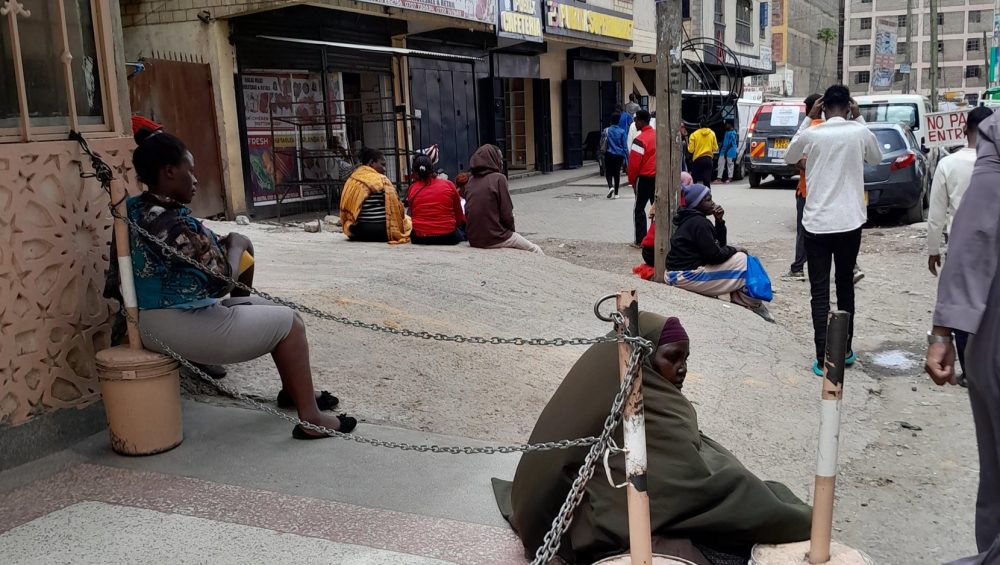
From 2018, the surge of innocent Karamojong girls in Eastleigh became a common sighting as they moved in droves and slept on shop verandas in groups. Despite being legally ineligible to work, they worked from one house to the other often being harassed, overworked, and underpaid due to their vulnerability. Some would work the whole day only to be threatened with being reported to police for being in the country illegally. This was a common trick used by many employers who wanted to extort ‘free’ services since deportation was the last thing they would liked to hear. While most slept outside bearing the Nairobi cold, a few lucky ones were accommodated by their employers. The rest had to figure out how to work during the day while sleeping on verandas and pavements at night. This is the price they had to pay as they chased the slippery, evasive promise of a better future. Despite being brought up in an environment where Swahili is a foreign language, their quick grasp of the language when in the city, combined with their resilience to face adversities, has enabled them to survive in Eastleigh and adapt to the different lifestyle while creating social infrastructure with local communities. They also chose to live a very communal kind of life akin to the one they left behind allowing them to care for each other as they involve themselves in the care work for their employers.
Through our inquiries, we came to learn that some were in mutually beneficial ‘social contracts’ with twilight girls in Eastleigh. The contacts allowed the teenage girls to have a place to spend the night as they looked after the kids when the twilight girls were out for the night seeking clients. This symbiotic agreement saved a lot of the girls from the inclement cold nights. Others who failed to secure such deals had to work day and night, do domestic work during the day, and join the “parking” (colloquial term for call girls as they wait for their clients) girls at night. It was child labor during the day, and child prostitution at night.
The desperation of getting a foothold in the city led these girls to accept meager wages, open to sexual abuse and exploitation from their Somali employers. With time, Somali women developed a preference for migrant Ugandan girls whom they described as very affordable, naive, and hardy who could be exploited for their benefit. This aged out Kenyan workers from the informal domestic and care industry in Eastleigh which was now starting to be a specialty for migrant workers. These girls continued to work under deplorable conditions since they had little expenses as they survived on bare minimums and those who rented did so in large groups to cut down on expenses. This arrangement allowed around more than five girls to stay together in a single-roomed shack in Mathare and the surrounding neighbourhoods. Their close-knit living in Mathare bore Kampala Ndogo (Little Kampala) where most of them are found. The strength of the Kenyan Shilling over the Ugandan one gave them an advantage which allowed them to remit some cash back home however little. To the Kenyan women who used this industry to meet all their needs, this disadvantaged them and it was only a matter of time before the two groups clashed.
One Saturday morning in early 2021, these two groups clashed as the Kenyan side cried foul of their Ugandan counterparts who were being blamed for lowering minimum wages in the domestic labor market. This altercation which lasted a whole day disrupting traffic along Juja Road, quietened after a week of ‘inactivity’ from the Ugandans. Despite the ugly side to this face-off, a beacon of hope was born at MSJC; Kenya Dhobi Women and Domestic Workers Network. Domiciled at MSJC’s office, this network which is owned and championed by the domestic workers themselves, helps exploited workers coalesce around their challenges and raise awareness while using the platform as an alternative to the overly bureaucratic workers’ unions that have continuously failed the proletariat in their organizing struggles against the capitalistic hegemon.
Today, the movement of workers continues, out of Eastleigh, for those whose hopes have waned, lives drained and who feel their dreams have been nipped by the monstrous hustle-hard system of exploitation and in for those who are attracted by the glittering of the business district, and within and about it’s streets for those still holding the hope for a better tomorrow.
Gathanga Ndung’u,
A scholar-activist, human rights defender and community organizer with Mathare Social Justice Centr (MSJC), a political organizer with Revolutionary Socialist League (RSL) and a member of Kenya Organic Intellectuals‘ Network.
gathangandungu72@gmail.com