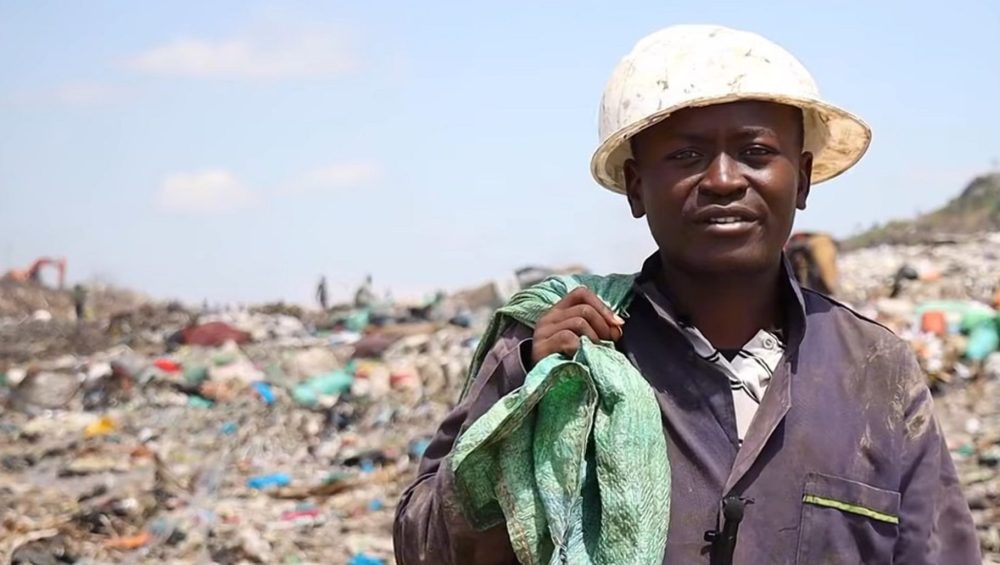
“Dandora dumpsite is extremely dangerous. It’s hard to get in because street gangs control their territories of operation, but once you are in, it’s even worse. People do hard drugs, there is raping and even gang raping of street girls and in many cases, there is a very high likelihood of one getting murdered.”
In 2004, Andrew, who would many years later come to be known as Kenyan Andy, was born in Minnesota, the United States of America. At the time of his self-consciousness and realization, he found himself in a local foster care, (children’s home).
Seven years later, well wishers, a Kenyan Man (Richard) living in the state of Minnesota, accompanied by his wife, an American national, who had come visiting the foster care a few times before chose to adopt Andy.
They lived together as a family until Richard lost his teaching job in Minnesota, so the family relocated to California, where his wife was originally from.
It was while at California, where Andy’s life started to change.
“I was treated differently and I believe it was because of the color of my skin. All the other children in that home were white; I was the only black kid. Also, in Minnesota I was an only child and all the attention came to me, but here, it always looked like I was competing with the other kids,” Kenyan Andy said.
He later explains that he could get in casual fights with the other kids at that home over minor issues and all the time, a guilty verdict would be passed to him in favor of the others.
He wasn’t welcome there, and he felt it.
A short while later, Richard’s mother back in Kenya, who had been sick for a while, was getting worse. She was suffering from the last stages of a cancer and so a decision was made that the family would visit.
Andy’s transition to Kenya
In 2016, Kenyan Andy, accompanied by his foster parents and other kids left California to Kisii County in southwestern Kenya.
Here they spent about two months taking care of Richard’s mother who later passed away.
After the burial ceremony, it was time for the family to return to their lives in the United States, which is where all hell broke loose for Andy.

Photo/Courtesy
“The family ordered for two taxi cabs which were to transport us to the airport. My family, (foster parents and other kids) sat in one cab and I was asked to seat on the other all by myself. We were supposed to meet at the airport in Nairobi,” Kenyan Andy recalls.
After a long silent trip, it was evening hours, and the driver designated for Andy came to the end of his trip just near the airport. He told Andy that he was instructed to get out and wait at that area.
It was a new area, NOT inside the airport, but Andy recalls seeing the airport right ahead of him (through the fence).
“I was near the airport but not inside,” He recalls.
He chose to do as was instructed, and wait.
It was a waiting that never ended. Several hours later, it was night, about 9PM; Andy seated all alone, cold and scared. He didn’t know anyone, didn’t have a phone on him and worse, didn’t speak or understand Kiswahili.
At this point, the reality sank in. He had been played.
***
Two days later, a group of about 7 boys approached Andy, where he was sleeping. He had decided to make himself comfortable by the street wondering what to do with his life.
By this time, everything he had on him, including his documents, had already been robbed.
The boys (who appeared to be street boys) approached him with the intention of doing what others had successfully achieved, but there was one with very a very strict code. He just does not rob! He appeared the responsible one in the pack and politely approached Andy.
John Kamau
John Kamau was the responsible young man that stopped the others from harassing the kid seating all by himself in the hours of the evening, by the roadside all alone.
“We were hanging on a delivery track that delivers food to the airport and it dropped us just a distance from where we saw Andy. He was seated all alone and cold in the evening and didn’t seem to know where to go,” John explains.
He approached to talk to him in the usual Nairobi’s Swahili dialect with Andy just staring and not picking a single word. At this point, Andy was scared of speaking to strangers because not only did he not know the Swahili language, but his deep Midwestern U.S, Minnesota accent was all over his lips. Whenever people spoke to him for those two days in that street, they thought he was pretending and harassed him.
“You know, I am black, at this point was homeless living in the street and spoke with an American accent. They just thought I was pretending and were angered even more,” Kenyan Andy says.
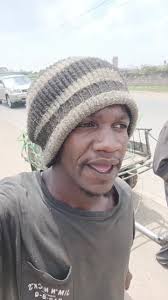
Photo/Courtesy
After a few attempts, John Kamau decided to switch to English.
Now this is where it gets interesting. John Kamau, though coming from a humble background, had grown fond of foreign Accents through watching British and American movies and series. He had particularly grown fond of the British accent and whenever he spoke with his friends, he would pull out a few lines that he had memorized and was doing a great job at it.
Upon hearing Andy, he couldn’t believe it. Much as his practice was largely towards the British accent, he was overwhelmed by the thought that someone would help him practice a foreign English accent, and without hesitation, offered to take Andy with him.
Of course he had interrogated Andy and learnt a bit about his situation and realized that there was no way forward for him at this point, so he chose to go home with him.
At John Kamau’s home, the mother was a bit skeptical with all manner of questions.
“Where did you get him? What if the police show up, you need return him!”
That night Andy got food and a comfortable place to sleep. The next day, Kamau would offer to take him to their aunt’s place in Kiambu County, central Kenya, to perhaps stay there for a few days as he tried to ‘figure things out.’
John Kamau narrates that it was a bit hard for Andy to cope in Kiambu because of the ‘extreme cultural differences and language barrier.’ Most people in that homestead only spoke Kikuyu and Andy was only familiar with his English with a taste of that U.S Midwestern accent that I talked about.
A decision was later made to bring Andy back to Nairobi, where they later moved and rented a small place in Dandora phase 2 and lived as roommates.
This however meant that they had to work and share their bills. John Kamau, who was familiar with the area, had been doing menial casual laboring in the neighborhood and especially at Dandora dumpsite.
Dandora dumpsite is a massive landfill in Nairobi, Kenya that’s one of the largest in Africa and arguably the largest in East Africa. It’s an environmental and health hazard that impacts the surrounding community, located in the Korogocho slum, less than 8 miles from the UN Environment Programme building. It receives 2,000 tonnes of waste per day from Nairobi residents and businesses which includes domestic, industrial, hospital, and agricultural waste. (Source: AI Review on Google).
The work John Kamau did here, which is what Kenyan Andy would pick as a means of survival going forward was the collection of metal and plastic, sorting and separating them and selling them to recycling vendors. The metals would be weighted by scrap metal buyers and the plastic also have recycling plants that purchase.

Photo/ Courtesy
It’s a common job done by most street children and other people in need of survival in informal settlements.
Kenyan Andy recalls getting terribly sick almost to the point of death within his first two months.
“I was so sick, I thought this was the end for me. John would buy pain killers to relieve my pain, then some eggs and milk. It was all he could afford, and we wouldn’t be able to afford any hospital or healthcare,” Andy narrates.
He later says that his healing happened miraculously and from then on, he has never been that sick. He just ‘simply appeared to have ‘adapted’ to the environment,’ but there were other challenges too.
“Dandora dumpsite is extremely dangerous. It’s hard to get in because street gangs control their territories of operation, but once you are in, it’s even worse. People do hard drugs, there is raping and even gang raping of street girls and in many cases, there is a very high likelihood of one getting murdered,” John Kamau narrates during an interview with a local TV show.
John further adds that in that dumpsite, many people are given coded street names that are extremely weird and almost reflect one’s present condition. The names also are at times used to hide the real identities of the people working there for various reasons.
“Most people there commit crimes and could be targeted so the names help keep away the true identity of the people there,” Kamau says.
He also reveals that they used to call Andy ‘Marehemu’ a Swahili word for the dead.
Andy also says that when he learnt the meaning, he quickly dropped it.
“It’s a terrible name. Why would you call someone that,” he says, and lucky for him, his name, Kenyan Andy stuck.

Photo/Courtesy
In the dumpsite, John explains that one would barely survive without protection from a crew, and luckily for Andy, John’s crew was ‘okay with him, they understood him and treated him like family.’
Also lucky for Andy, John Kamau does not do drugs and his crew understands that. This was a good chance for Andy because he had never and had no intentions of trying the drugs that seemed readily available at the dumpsite.
“In my past I had this deep connection with the church. There is no point in time where I saw myself doing drugs.” Kenyan Andy says. He further adds, “I encourage people not to take drugs.”
Andy’s Passion
Kenyan Andy is largely interested in Music. He has a deep connection with music. Though John describes him as an ‘introvert’ and mostly ‘antisocial’, he also notes that Andy finds a lot of solace and relief in good music.
By press time, he has already released two music tracks, which largely depict his troubles and lifestyle.
“A well wisher saw me rapping on TikTok and thought I was good so he offered to pay my studio fee,” Andy says.
Both Kenyan Andy and John Kamau are very fond of social media and particularly TikTok, and have found themselves with massive followers overtime. They just basically document their day to day lifestyle at the dumpsite and other places.

Photo/Courtesy
Kenyan Andy also uses his TikTok and YouTube Channel (both by the name, Kenyan Andy), to promote his music as he documents his lifestyle as well.
The Media
Kenyan Media, after the duo made their lives public through documenting their lifestyle and stories on social media, picked a lot of interest. They have been also particularly interested in the story of Andy which is quite frankly, unique, further conducting interviews and shows.
This publicity has helped them to some extent to move a few steps forward through well-wishers and boost their reach on social media.
They still say they need as much assistance as they can get and one can always reach out to Kenyan Andy through his social media handles all by that name.
Kenyan Andy in particular wishes to further his career in music which is the one thing that ‘keeps his spirit alive.’
Conclusion
John Kamau describes Kenyan Andy as a very respectful person. Though quiet most of the times, he is a hardworking young man that you can easily get along with.
“He is a chilled guy. He is mostly quiet, but he is a good guy and I respect him a lot,” John Kamau said.
Kenyan Andy on the other hand describes John as a supportive friend.
“He is a supportive guy. He was there for me when no one else could be there. He chose me when no one else could,” Kenyan Andy said.
Both remain optimistic that the future is bright and they will get there successfully.
“It may take long, but it will come,” Kamau said.
END