
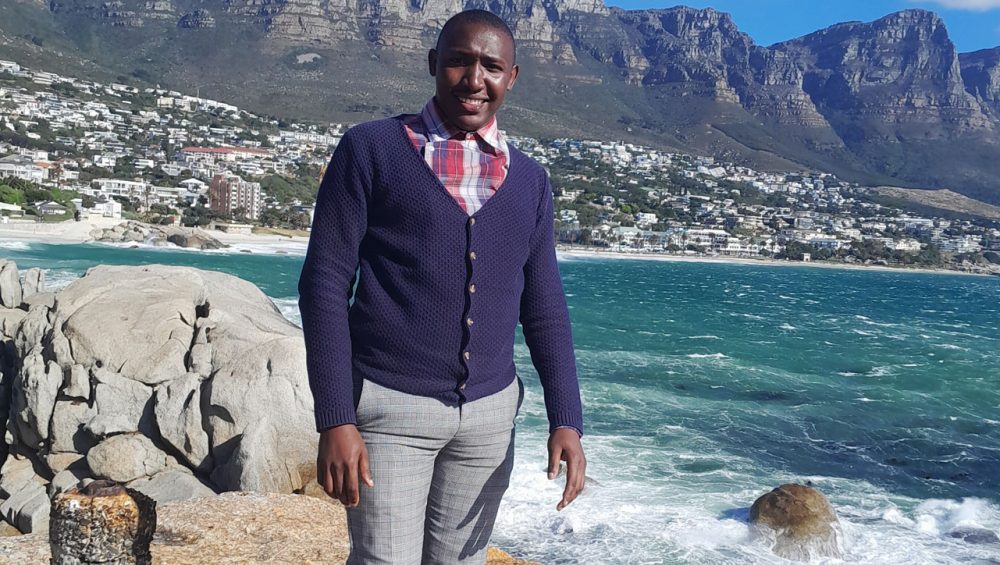
“… after about 20 minutes, the driver appeared from the other end of the junction, I confirmed the plate registration then proceeded to wave. His headlights were full to allow him assess me properly. When he saw a black man, with a cap, standing in darkness, he screeched his car’s tires as he sped off fearing for his life… that evening I had to trek more than two hours to get home…”
I know we have all wanted to move, probably go far away where the grass is greener. To start afresh, to experience new things, and especially good things. We all want and wish to be ‘shocked’ culturally in a good way. I don’t want to say I’m differently weird or special in any way, but personally, I didn’t care embracing yellow(er) or brown(er) grass on the other side of the continent. I was ready for all manner of weird, awkward, shocking, awesome, beautiful, fulfilling and anything in between.
On February 6, 2023, I decided to relocate to Cape Town for my postgraduate studies. I wanted to see what color the grass could be in this famed touristic city. From the crowded Nairobi Eastlands or Eastlando as we call it in slangto the posh neighborhood of Rondebosch, which was to be my home for the next one year plus as I undertook my post graduate coursework. I was in a new world, no friends, no known neighbors and no relatives or family, apart from my phone and my overly overcrowded mind.
During my primary and secondary history classes in Kenya, I learnt a lot about South Africa and their torturous struggle to unyoke themselves from the nefarious Apartheid regime. How they sang their songs of freedom, the stories of resistance in Sofia Town, the Sharpeville Massacre, and not forgetting the students riot of 1970s and Sarafina (the movie) as an icing of the struggle. Chris Hani, Winnie Madikizela, Nelson Mandela and other freedom heroes, played their part. I was very eager and anxious to see this country that the colonial powers were not willing to let go of till it became very apparent that staying through apartheid was untenable for the people of South Africa.
. . . . . .
Every evening, I would stroll in Rondebosch, Newland, Claremont and the surrounding neighborhoods. They were quiet, neatly planned, secured with electric fence and private security personnel everywhere. In the south, things were different, private security personnel outnumbered the South African Police (SAPs) by far due to the rising demand as a result of insecurity. The security industry is a multi-billion-dollar industry in South Africa. While walking, I could see this is a white or upper-class suburb. From an old white couple walking to stretch their aging and curved spines, to a seemingly middle-aged career white man jogging, to a young couple walking their dogs and cats. It’s a whites only neighborhood, at least not de jure but de facto. Naively, I believed my innocent thinking that racism ended in 1994 with the declaration of the rainbow nation by the founding father. While walking, my mind always whispered to me to check if there are any sign posts written “whites only” or “Blacks not allowed” or “colored facility”. I saw naught any. One day, while strolling, I stopped at the end of a road, next to a well-kept lawn. On the lawn was a bench donated to the City of Cape Town (CoCT) probably by a couple that lives around to help the elderly as a “recharging point” when strolling in the evening. The name of the couple was neatly ingrained on the back rest of the bench with the donation date. I sat there comfortably enjoying the cool breeze descending from the back side of the Table Mountain through the Newland and Kirstenbosch Forests. As I sat, I looked around for any sign or any accidental relics of racial segregation in this Mother City. I didn’t see any, all I saw was a peaceful society co-existing. From one corner was a taxi waiting for a few more passengers to overload the 16-seater past its limit while at the same time, a Golden Arrow Bus carrying predominantly colored passengers sped off past the taxi. Oops, I was not keen enough, I had not seen the pattern! Yes, it’s a rainbow nation, but the colors do not meet, nor do they tangle nor their edges blur into each other while transitioning as real rainbows do. This one is a weird ‘rainbow’ where each color maintains its well-defined line to the end. The public taxis are predominantly Xhosa’s and other black natives’ preferred mode of transport. The colored communities and middle class prefer the Golden Arrow Buses or carpool to work, while whites and/or upper class use their private means. When I climbed to the top of Table Mountain, I saw a city whose resources, infrastructure and investments are concentrated in the city Centre and surrounding areas such as Camps Bay and Clifton Bay, and as I moved my eyes outwards to the Cape Flats which harbors colored and middle-class populations, this city’s lustre waned just like concentric circles of a water ripple. To the furthest end of the city are the Khayelitsha and Philipi Townships (informal settlements) areas which are predominantly inhabited by blacks. It’s a three-tier city with core, semi-periphery and periphery. This is the rainbow I saw in South Africa.
. . . . . .
One day afternoon I decided to attend a summer concert at the invite of a friend. The concert ended a few minutes to 6pm. We parted ways and I had to walk to the exit area as I tried ordering my ride online through an e-hailing platform. I sat on a bench while I attempted severally as they failed to respond. After more than 40 minutes of trying, waiting and canceling, darkness had started setting in, and all the cars in the parking lot had left. I decided to walk as I tried my luck along the dark narrow road which was sandwiched by trees from each side. No one dared stop their car to help an unknown black guy walking in the dark in an area where everyone drives their personal cars. Luckily, one driver responded from the application but he had to first call, listen to my voice, then listen to his ‘gut feeling’ before making a final judgement on whether to come or cancel. Luckily, he agreed, I guess my foreign accent helped. However, I was to wait for another fifteen minutes at a traffic lights junction. As I waited, load shedding-a scheduled power black out-rolled in the whole neighborhood, leaving me in pitch darkness. Even the traffic lights went off. I stood there, shivering due to the cold, in the darkness with my not-so uptown kind of a cap on my head. After about 20 minutes, the driver appeared from the other end of the junction, I confirmed the plate registration then proceeded to waive to the driver whose headlights were full to allow him assess me properly. When he saw a black man, with a cap and standing in the darkness, he screeched his car’s tires as he sped off fearing for his life. I was left my mouth wide agape trying to understand what had just transpired. That evening I had to trek more than two hours in darkness to get home. I later came to discover that being a black man past some hours is a warrant enough for arrest or for one to be labeled a criminal. And for my case, I was out of what is considered a black neighborhood. I didn’t belong there, so what was a black guy doing in a whites’ neighborhood at such odd hours? The driver had all the rights to be cautious in a country that registers more than 27,000 homicides in a year. I was learning tough lessons outside class.
. . . . .
As my debut story on Migrant Narratives Africa, I don’t want to scare you with my racist encounters, or bore you with crime and xenophobic tales. I would love to give you a taste of Mzansi which wowed me.
I think every entry point such an airport or a seaport should have a user manual for foreigners to have basic understanding of the dos and don’ts, words and phrases commonly used, and those not used in a standard way among many other guides and hints on how to survive and what to find where. For example, in Kenya, the user manual should clearly define that fisi (hyena) is in many instances not referring to the four-legged scavenger in our wild savannahs but also to a well-clad young man with a habit of hitting on any woman who passes by his business premises or that random M-Pesa (mobile money service) agent who goes ahead to text you after you have withdrawn your money from her kiosk. The term sponsor should also be defined in the same manual to show that a sponsor is not necessarily an organization offering monetary support to another like in the case of Sportpesa to Gor Mahia Football Club, but also an old, grey-haired man financing the comfort and extravagant life of a late teenage girl in exchange for conjugal indulgence.
While in South Africa, I got lost more than I could keep track off when strolling leisurely in the evening. When I failed to understand my Google Maps, I could ask a local for direction who could use ‘garage’ and ‘robots’ as landmarks. In South Africa, a garage is not a car clinic as we are used to, rather, it is a fuel station while robots are traffic lights and a roundabout is a circle! I decided to ‘confront’ my Xhosa and Zulu classmates about misappropriating English names. I was left arguing alone after an hour of heated argument that involved downloading images of robots, garages, roundabouts and street lights. I had to accept It’s their South ‘Africanized’ English just as our unusual use of sponsor and hyena.
Adapting to Cape Town was somehow easier than I had expected, I enjoyed boarding the taxi vans though different from our graffiti-filled matatus which are, in most instances, moving mini-discotheques, in Nairobi, Kenya. I enjoyed sitting around chatty Xhosa women doing stories with strangers about anything in the taxis. I loved to listen, for the first time, click sounds in a real conversation. For me it was a reminisce of my childhood movie; The Gods Must Be Crazy. I enjoyed listening the different clique sounds during their banters though I never understood anything apart from the few words that are part of the broader linguistic continuum of Eastern and Southern Bantus. In most cases, I would coyly pretend to be staring at my phone as I laughed or smiled due to their funny intonations, clique sounds and their common unnecessarily thunderous laughter. The taxi atmosphere is a reminder of the matatu one before mobile phones. Whenever a passenger boarded the taxi, he or she had to start with molweni (hello) before proceeding to sit and join the conversation that mostly arose out of anything and sometimes, from news items on the radio system in the taxi. I enjoyed the conviviality among passengers and driver during the rides, my only worry was to avoid too funny jokes that would leave the driver uncontrollably looking elsewhere while we headed for a ditch or an electricity pole. In most routes, the driver had no conductor and so the passenger who sat in front next to the driver had to be volunteered to be a part-time tout, which duties was to collect our fares and give back the balances as per the informal ‘social contract’. In most cases, we collected the fares and sorted our balances before giving the driver the exact amount required from a certain number of passengers. I loved the honesty and transparency in the taxi industry. I was always assured of getting my balance back even if it meant being reminded when alighting at my stop. This is unlike in Kenya where a passenger is required to pay immediately but takes ages to get back their balances and one has to set a reminder on their phone not to forget, because if you do, they also ‘forget’ giving back. It’s Nai-robbery, one has to find ways to make an extra coin.
South Africans love their culture, from their names such as Siyakuthanda (we love you), to their amapiano and ngom (pronounced with a clique sound) songs. Their lives revolve around their socio-cultural and political identity which they heavily fought for in a very protracted struggle. The people are inward looking consuming their content only and with most people being unaware or informed about what’s happening in the neighboring country or anywhere on the continent. Mzansi is their business and its their duty to love their business.
Cape Town is a touristic city that every traveler has to see in their lifetime. It offers nature with world class infrastructure, culture with modernity, and a meeting point for all cultures in the world. I will still choose to go back again and see if there are other colors of the grass, perhaps purple or red this time!
Gathanga Ndung’u,
A scholar-activist and human rights defender with Mathare Social Justice Centr (MSJC), a political organizer with Revolutionary Socialist League (RSL) and a member of Kenya Organic Intellectuals’Network.


4 Comments
We learn a lot fróm such narratives. “I was learning tough lessons outside class.”😊
Kudos brother Sam
Welcome
Can you be more specific about the content of your article? After reading it, I still have some doubts. Hope you can help me.
Hello. Could you be more specific on what areas you need clarification. This was more of an experiential view as a first tike visitor in Cape Town