These scams, often orchestrated by organized crime syndicates, involve luring individuals with false job offers and then coercing them into participating in fraudulent activities.
This article comes at a time when 48 Kenyans rescued from Myanmar have arrived home and 77 others still awaiting repatriation, by press time.
East Africans, including Kenyans, have fallen victim to deceptive recruitment practices that promise legitimate employment opportunities in Southeast Asia but instead lead to exploitation in online scam operations. These scams, often orchestrated by organized crime syndicates, involve luring individuals with false job offers and then coercing them into participating in fraudulent activities.
This article comes at a time when 48 Kenyans rescued from Myanmar have arrived home and 77 others still awaiting repatriation, by press time.
Many are lured by fraudulent job offers promising high salaries only to find themselves trapped in Myanmar, forced into scam operations and subjected to abuse. East Africans, primarily from Kenya, Ethiopia, and other countries, are being trafficked and coerced into participating in online fraud schemes. These scams are ruining lives and trapping people in a cycle of exploitation. As troubling as it is, international authorities have only recently begun to fully uncover the scale of this dark network.
In late 2023, the United Nations estimated that at least 120,000 people were trafficked into Myanmar to work in scam call centers. These centers, operating in “special economic zones” along the border, are part of a broader Southeast Asian network generating billions annually through fraudulent activities.
The False Promise of Better Opportunities:
It all begins with a simple ad on social media or an enticing online job posting. According to a report from Lemonde, these advertisements typically promise positions like customer service representatives, bilingual sales specialists, or translators with salaries that seem too good to pass up. For many East Africans, these job offers are too appealing to ignore, especially when faced with the harsh economic realities at home. Many are simply seeking a way out of poverty, hoping that this new job could offer a path to a better life.
One such victim, an Ethiopian woman who was trafficked to Myanmar, shared her experience: “I was promised a great job and a chance to build my future. But once I arrived, they took everything from me. I was forced to work in a scam center, and I couldn’t leave.” Her story, like so many others, reveals the horrifying truth behind these fraudulent offers.
The Shocking Reality: Forced Labor and Abuse in Scam Centers
Once these victims are transported to Southeast Asia, their hopes of a new life are dashed. Nation Africa reports that these individuals are often transported from Thailand to Myanmar, where they find themselves in “scam centers.” These centers are essentially forced labor camps where victims are coerced into running online fraud operations. The reality of these centers is grim. Victims are forced to meet impossible financial targets—sometimes as high as $50,000 per month—by defrauding people, primarily from Western countries. The scams typically involve “pig butchering” schemes, in which victims build fake relationships with targets to convince them to invest large sums of money in fraudulent schemes.
One victim from Kenya, who was rescued in a Thai police operation, recalls: “I was made to work long hours, sometimes without food. If I didn’t make enough money, I was punished. I thought I was going to die there.” This is the grim reality that many East Africans face once they arrive at these scam centers, where the constant threat of violence and abuse looms over them.
A Growing International Crisis:
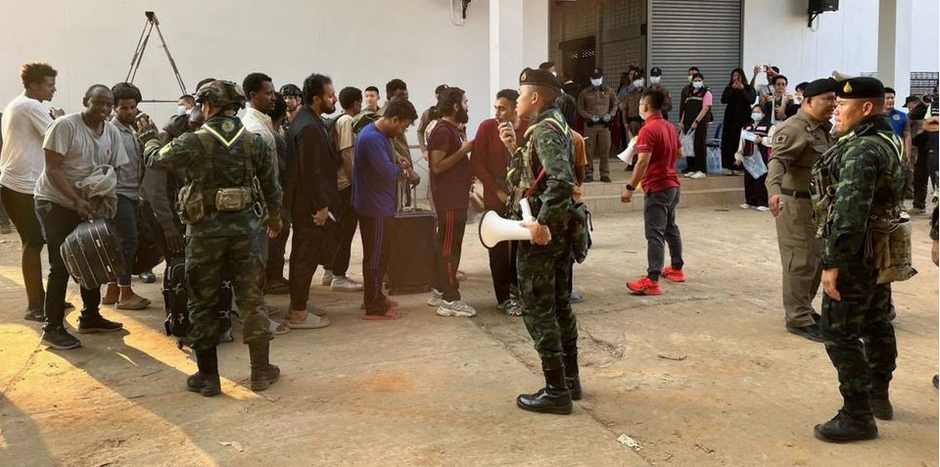
The scale of this issue became undeniable when Thai authorities, in February 2025, rescued 138 Ethiopians and 23 Kenyans from forced labor camps in Myanmar. According to a Reuters report, this rescue operation highlighted just how widespread and organized these trafficking networks have become. Despite being freed, many of the victims remain traumatized, and their journey home is far from guaranteed. Repatriation efforts are complicated by bureaucratic challenges and a lack of support networks for the victims once they are freed.

Photo / Courtesy
As The Guardian highlights, these scams are not isolated to Myanmar. The criminal syndicates responsible for these trafficking operations span across Southeast Asia, operating in countries like Laos and Cambodia, where they continue to prey on vulnerable workers. These operations are financially lucrative, with billions of dollars generated annually by fraudulently obtained funds. Yet, the perpetrators continue to operate with little interference, thanks in part to the lack of coordinated international enforcement.
The Role of Social Media in Fueling the Scam:
The growth of social media has made it easier for traffickers to target victims. Platforms like Facebook, TikTok, Instagram, and LinkedIn are often used by these criminals to advertise fake jobs, targeting individuals who are desperate for work. The perpetrators go to great lengths to ensure their scams appear legitimate, with professional-looking websites and convincing offers that look like real business opportunities.
According to ISS Africa, the proliferation of these fraudulent job advertisements on social media has made it harder for job seekers to distinguish between legitimate opportunities and scams. The platforms themselves are often slow to act, despite mounting evidence of the widespread abuse taking place. “These platforms are like a hunting ground for traffickers,” one victim explained. “They knew how to manipulate us, and they used our desperation against us.”
Governments, tech companies, and advocacy organizations must work together to raise awareness about these scams and improve the detection and removal of fraudulent ads. As Lemonde suggests, creating a global partnership to monitor online recruitment ads could go a long way toward preventing future exploitation.
Rescue Operations and the Road to Recovery:
The rescue of victims is a beacon of hope, but it’s only a temporary solution. For many who have been trapped in these centers for months or even years, the scars of their experiences remain. Nation Africa reports that many survivors struggle with trauma and PTSD, with little support in their home countries to help them reintegrate into society.
While rescue missions are crucial, they cannot solve the root causes of the problem. As noted in a report by ISS Africa, East African countries must prioritize education and economic opportunities for their youth to prevent them from becoming vulnerable targets for traffickers. These nations also need to strengthen anti-trafficking laws and work with international bodies to ensure that perpetrators are held accountable. “It’s a huge network, and it’s going to take more than just raids to dismantle it,” said an investigator with the Thai police. “We need stronger international collaboration and better prevention strategies.”
Conclusion:
While international rescue operations have brought some relief, many victims remain trapped in a system of abuse, unable to return home. The scam centers in Myanmar and beyond continue to operate with impunity, generating billions in profits while leaving a trail of destruction in their wake. Tackling this issue requires a coordinated international effort, stronger laws, and a better understanding of how social media and online recruitment platforms can be used for harm.
As one survivor of the scam centers put it, “We came looking for a better life, and instead, we found a nightmare. No one should ever have to go through what we went through.” Until more is done to raise awareness, support victims, and punish traffickers, these nightmare scenarios will continue, and more lives will be destroyed.
Sources:
- Nation Africa – “23 Kenyans, 138 Ethiopians Rescued from Myanmar Scam Centers”
- Reuters – “Scam Hubs on Thai-Myanmar Border Still Have Up to 100,000 People, Thai Police Says”
- Lemonde – “How the Chinese Mafia Kidnaps Africans to Swindle Westerners”
- ISS Africa – “East Africa’s Youth Scammed by Promises of Overseas Work”
- The Guardian – “Thousands Rescued from Illegal Scam Compounds in Myanmar as Thailand Launches Huge Crackdown”