As I speed off to my next adventure, the life of the nomads will continue to hang still on the pendant of time and dunes until a moment arrives where environmental and economic conditions stealthily and steadily pull them out of the desert, thrusting them into towns, involuntarily deleting their existence! What a privilege to meet them and participate in their life!”
MAURITANIA – PART 2
(Read Part One here)
The Narrative of Sonia Shah
After my first nomadic expedition, another set of far more remote nomads hypnotises me… And so the quest for the Enmadi nomads, as well as more reclusive nomads, begins. The nomads once used to hunt for animals with wild dogs, but as the animals diminished with time, their hunting days for meat came to an end! Now it’s just large plates of pasta/rice with very few pieces of meat from their goats and camels, but as a rare treat!
A 4-wheel is needed to manage the tough and far-out terrains where some parts aren’t reached by any public transport. Only one operator is willing to undertake the mission due to some experience with these nomads. The others felt my requests are unusual and too far-fetched. The very few others who are willing to take me out into the wild are charging double! And so, I leave it to two brothers who run their own agency to take me to the unknown, but Hadrami, the owner, states that he can’t guarantee me some of the encounters I wish to experience, especially tracking a particular kind of nomads – the Enmadi.
I appreciate his honesty and decide to take the plunge of possible, utter disappointment, time wasted, and flushing my cash with its head buried in the sand along with mine!!
I go in good faith, and we come across nomads who welcome us with a bowl of mixed camel and goat milk, but as always, it’s doused in lots of sugar, and I politely decline. The ceremonious tea pouring and drinking custom commences, as is often the tradition throughout the country.
I’m surprised and delighted to see the family have created their own vegetable garden, with various greens sprouting from the middle of this desert. They’ve placed an impressive irrigation system in these arid regions. The wells aren’t too far either, but they’re not solar-powered like the other wells I’d seen the nomads use near the town of Chinguetti. At least, that’s the first sign of some remoteness where these paths haven’t been easy for any NGO to access and plant a solar system to facilitate water supplies.
I assume the vegetable garden will make a pleasant change to their usual meals consisting mainly of pasta or rice with very few pieces of meat… but as time passes in this land, I notice that Mauritanians in general will dominate their dishes with vast amounts of carbs and perhaps five small pieces of carrots in between – whether they’re urban dwellers or nomads! And the large plate of carbs with minimal meat or vegetables is shared between three to five people!
Equally, my vegetarian meals over the next eight days consist of monotonous and haggard-looking vegetables. Thankfully, I’d anticipated this, and fortunately, I’ve stacked up on various nuts, seeds, and dates from the capital prior to the trip and requested my guides to purchase various fruits! I’m sure I’ve dropped a few kilos already, and this could perhaps be another kind of diet to peddle to the masses and to Hollywood. Add the words “Nomad desert diet” to enhance the exoticism is all that could be needed to market this new fad. It sounds a lot more interesting than the new rice hack that Jennifer Aniston and Lopez have been perforating the internet with recently!! My idea has a few pieces of carrots compared to the celebrity rice hack at least! My fantasy is short-lived as by the fifth day, I’ve had enough of the niggardly carrot and rice dish, and I urge my guides to find other vegetables once we hit some kind of “civilisation” before continuing to source more nomads who live out even further!
I bid my farewells to the family. We continue prodding through the apricot-coloured dunes, and another group of nomads appear.
This time it’s clear that my two guides have never made acquaintance with this family as they had with the initial one from the morning. I’m surprised how they don’t mind a bunch of strangers walking in and making themselves feel at home. The usual custom of copious amounts of tea and camel or goat milk are offered, along with lots of rice and barely anything else in it.
A lot of bantering goes on right from the start between my guides and the family… and as the sun’s rays soar, my guides and I casually take a nap in the family’s tent while they relax. Hadrami, my guide, later explains why there are no qualms in turning up at random strangers’ homes and doing as one pleases comfortably!
“Here in Mauritania, we live in solidarity and welcome strangers!” I easily believe that as I recall the hospitality I received in another town when a TV crew company offered to lodge me at a festival where I’d turned up with no place to sleep, and of course, Hadrami himself had offered me some shelter for a couple of nights in his vehicle – the very same pickup that I was now trundling in across various desert terrains.
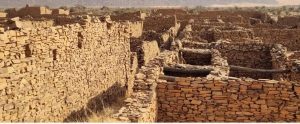
Soon we pitch up in Tichit, a small town in the Sahara where locals’ homes all appear in standard black-grey stone slabs slapped onto each other against the different hues of the desert. Once more, we camp at strangers’ homes, welcoming us rather than shunning us, as would be the custom in many corners of the world! There is no vegetable garden growing where they are, unlike the other family that I’d encountered earlier on.
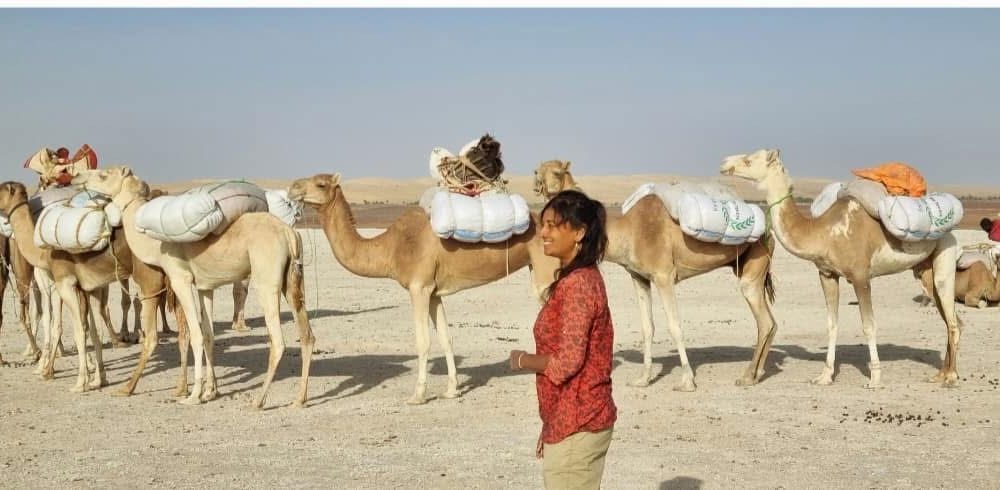
The following morning, just after sunrise, we head towards the camel salt caravans. An entire herd of about 150 camels stand strong as their owners load their backs with several bags of salt that have been picked in the last two days from the salt flats in the cauldron of the desert.
After several hours, a necklace of camels lines up from around and behind each other. Each herder takes control of his herd of about 15 to 20, and they head out to trade their salt in exchange for either food in neighbouring Mali or money within Mauritania. Despite the heavy load, the camels gallantly saunter through with different shades of sand quilting the mountainous backdrop – each camel unperturbed by the 250 kilos steadied on each of their backs. The journey will last two lengthy weeks, and the herders will camp out at different spots in the desert with the camels.
We continue our journey, and at long last, we encounter the Enmadi nomads. Very few of them remain in the desert, as most of them have now ventured out into modern towns as times and conditions harden, and some even strive for education for their children – something that some families have only considered recently.
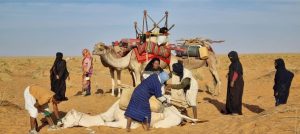
On the evening we appear, some of their tents are half dismantled! I learn that the following morning, they’d load all their belongings onto their camels and walk through the desert to dwell in a new terrain.
This was the luck I’d hoped to strike – arriving at the right time to witness their move and accompanying them through the dunes, the desert, and mountains to their new dwelling!!
I’m ecstatic as I’d hoped for such an encounter well before the trip had commenced. However, as my requests to Hadrami and his brother Ahmet seemed quite a tall order, I dared not demand to see nomads moving from one home to their next, as the shifts to new pastures aren’t frequent. The moves usually take place as a one-off encounter, after a month or two, and sometimes up to four to six months after squatting in one place!
I’m elated at the opportunity to assist with the move, from dismantling their livelihood one evening and loading them onto the camels the following, but I make a mess of it, and with the language barrier, I decide to leave it to their devices to sort out the camels and belongings accordingly!
The camels grunt away as they’re prompted to settle down for the loading to take place. The men join in the grunts too, as they complain that the women have far too many belongings. I chuckle at the common things women generally tend to share, whether they have a nomadic existence or a more urban one globally!
The men and my guides urge me to take one of the several vehicles that have been called to come through to transport the elderly women and children because the settlement they are moving to is 15 kilometres away, and they doubt my ability to keep up with their pace in the heat through the desert!
I snort back at them and remind my guides that I’ve already walked for 15 kilometres about a month ago, accompanying one of the nomad men to fetch water from the wells alongside his troop of goats in another part of the country.
My guides and the Enmadi men try to convince me that the terrains coming up will be different and more tedious than what I’d encountered.
I adamantly insist on walking with the nomads and camels, and a self-assurance builds firmly that I’m capable. I’ve already scaled several high mountains in different continents, so this should be a piece of cake!
My guides finally succumb to my stubbornness and drive off. The journey begins, and within only five minutes, the women are drenched in fatigue and insist on mounting the camels that are already loaded with their belongings.
Their men assume I may want to join and claim that I must be “fatigue!” – the only French word they know.
I adamantly state that I’ll continue walking alongside them. Soon, they assign me to be in charge of their troop of goats. The goats have no sense of direction and scamper all over the place, and I fail all attempts to excel in my goat-herding “skills.”
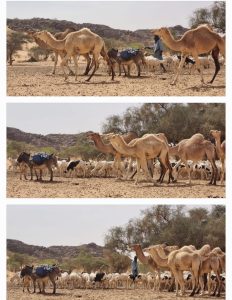
Once more, this is yet another chance for the men to stray all my attempts from walking and insist that I’m tired when I’m not.
I swap roles with one of the men. I slip a hooped rope attached to his camel around my wrist while the women and their belongings loom over me, and I start to lead them.
Everyone bursts out laughing as I take over the men’s role in wanting to lead the camels and women through.
Soon, I really do sink into exhaustion, but not from the heat, nor walking and ushering the camels and the bulk on them… but every few minutes, the constant word “fatigue” haunts me in the desert. It’s clear that the men can’t perceive a woman being able to do what they’re doing, even though I’m clearly keeping up with their pace effortlessly!
Soon, I decide to turn the tables on them. I decide to repeat in parrot fashion “fatigue” (tired to them)… and motion them to allow the camels to carry them with the women!
The women snigger away, and now the men are determined to add an extra gait to their step to show their strength.
Now it’s them who have to face my false assumptions as I hurl out “tired?” to them every few minutes.
As an hour goes past, a camel crumbles and groans, wanting a break, but all his grunts are ignored. The camel fervently shakes his hooves. A puppy dog belonging to one of the children suddenly falls out from the saddle onto the sand and whimpers. Finally, the men give the camel a break as he descends on all fours to the ground. The men hand the puppy back to the women settled above the camel and firmly tie it to the sides of the large upside wooden tray carrying all their wares balanced onto the camel’s hump.
Suddenly, I’m once more badgered to mount the camels. It’s clear that the men still believe that I won’t make it all the way from the few words of their language (Hasani) and falsely believe I could slow them down.
I mount the camel begrudgingly, but after five minutes, I insist on resuming my previous role of ushering the camels and the women with their belongings through the desert. The men ignore all my pleas until I follow the footsteps of the previous troubled camel. I start crossing my legs across the saddle and feign as though I’m about to jump!
The men gullibly fall for my act and quickly beckon the camels to come on all fours for me to leave their backs safely, and I continue with business as usual!
In between, wedding proposals for the younger men come my way. It’s usually the elderly men who find their sons a bride. One of them flexes his arm as a bodybuilder would to show me that his son needs to marry a strong woman and I ought to consider!
I chuckle away, shaking my head from side to side to show I’m not interested. A few more repetitive suggestions of matchmaking come through, and I let Cupid’s arrow aimlessly fly through with the occasional breeze!
At long last, the men leave me in peace to continue walking with them, and we silently enjoy the surroundings despite the afternoon heat steadily worming through.
The peaceful moments are suddenly broken when I see one of the younger men slinging a stone at me.
I’m about to launch out a verbal storm, but very swiftly, I realise that he wants to play “catch” with me as we walk our camels in a cohort!
I indulge in the frivolity. After a few stones darting between us, it’s a clear win for me, but the macho scrunching of the teenager forbids him to admit his defeat! He almost facetiously tries to flip out a much heavier stone for me to catch, but he is unable to carry the weight. I burst out laughing and resume the fun and games, competing with who can throw the desert rocks/stones the furthest. He glees with glory without any hesitation and glares at my defeat with a cheeky sneer.
We both receive a sneering telling-off from his father for slowing down the passage. Like two well-behaved schoolchildren, we continue trodden through in silence. Finally, we arrive at the finishing line, and already from a distance, the first group has started to assemble their new homes.
Also Read:
Mauritania – Staying and Walking with Nomads
As evening crawls in, we break out into a celebration of dance and music to celebrate their “new home,” and I gift them with an assortment of vegetables as their welcoming present and to express my gratitude for their hospitality and allowing me to be part of this striking trajectory.
The men still express their surprise that I managed to walk for the entire journey and comment that I must have some nomadic blood within my ancestors. I relay a similar comment that my brother recently made to me: “You must have some DNA from our ancestors in India, from the region of Rajasthan, where desert dwellers dominate the dunes!”
The following morning, we head further into the wilderness. The desolate contours of the cinnamon and cream desert notably magnify, and so do the herds of camels, donkeys, goats, and cows as we pull over to a settlement of another family of nomads. I’m stumped with the early afternoon activities lasting several hours! Men and women are leading either camels or donkeys to the well, attaching the livestock with ropes to a pulley to draw water out of the well – a practice that started centuries ago, and although quite obsolete in many desert areas, clearly it’s a system that hasn’t yet crumbled here, a settlement that is almost 200 kilometres away from the nearest village!
We drift a little further from this clan of nomads, and a young male is happy to welcome us. No doubt the notorious tea/camel or goat milk drinking resumes immediately, of course! No other family members surround him, as is usually the case elsewhere. His father has gone to search for wood with their donkey, and the mother and siblings have temporarily settled near one of the towns to educate the children. He informs us that he used to be in school but pulled out from continuing with his studies in medicine as he didn’t wish to leave his father alone in the desert and assist with some duties.
He is partly relieved to confine himself to these solitary surroundings as the villages seemed to be too busy for him. The only time he goes to the nearest village is when he needs to stock up on basic goods supplies. He travels once a month, and cars don’t really pass by here to offer him a lift, as some other nomadic families occasionally find elsewhere, but on a rare stint.
I’m stumped at the large distance he needs to cover each time with his camel, considering he is almost 200 kilometres away. My guides calm my unnerving curiosity and enlighten me that he doesn’t journey the same routes as we had. Thanks to his camel, he is able to find shortcuts through the desert to enable him to reach within a day or two, one way, to the nearest town. He sleeps in the desert should he need to camp the night out and continue the following day…
As the night waltzes through, the silhouette of an elderly man and his donkey loaded with firewood appear, and the friendly greetings and goodbyes the following morning assume.
Nine days later, the trip swiftly ends. Finally, I enjoy a shower and a hearty meal consisting of much more than just carrots and pasta/rice!!
As I speed off to my next adventure, the life of the nomads will continue to hang still on the pendant of time and dunes until a moment arrives where environmental and economic conditions stealthily and steadily pull them out of the desert, thrusting them into towns, involuntarily deleting their existence! What a privilege to meet them and participate in their life!
I reminisce at the time I met “Picasso,” a Senegalese running an art shop in one of the towns I needed to wait at to catch a connecting vehicle to another town after my first nomadic trip was over.
Feeling dejected after my guide from my first nomadic expedition shows his unprofessionalism through his lewd and coarse side, I decide to let go of him at Picasso’s and not continue on a second expedition with him despite him being knowledgeable. His pathetic attempts to insinuate inappropriate innuendos, though subtle, didn’t sit well with me!
I bemoan my frustration to Picasso, and he puts me in touch with a local who could possibly take me on the second nomadic expedition I wish to embark on. I have my doubts, but I contact the new guide, and lo and behold, he and his brother are the only ones in the country that can offer me a reasonably priced excursion and one of the very few who have the knowledge of the logistics!
Who knew an artist called “Picasso” would manifest a canvas of richness for me as I penetrate into the depths of the desert featuring various nomads! One door closes, and another one opens immediately to magnificence!!